Showing posts with label Kashmir Dispute between Pakistan and India. Show all posts

Saturday, December 11, 2010

Asia’s Biggest Glacier Cracking Thanks To Military Activity


GIANT CRACKS IN SIACHEN: A SERIOUS THREAT TO CLIMATE 


Arshad H. Abbasi 


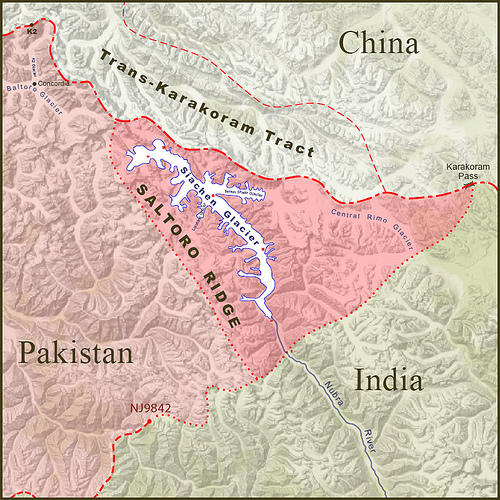
New satellite images show growing giant cracks forming through the Siachen Glacier, the second longest glacier on the planet. One of the most serious observations is the formation of a stream.

Development of cracks, streams, and glacial lakes show that glacier may disappear, if immediate measures are not taken by Pakistan and India.

The cause of these cracks is not global warming; rather it is the presence of the Indian army on the Siachen Glacier since 1984.  The glacier is melting at an unprecedented rate and this has already been reported. The melting has been attributed to the deployment of troops and establishment of permanent cantonments. However, decision makers of both countries have turned a deaf ear to this climatic disaster.  The Indian government is trying its best to associate the cause of glacier melting to the phenomenon of global warming, which is undoubtedly baseless and merely a case of evasion of responsibility.

Glaciers melt into glacial lakes, leading to the formation of a stream which later joins the Nubra River. This has been due to attempts by Indian army to facilitate movement of its troops. Indian army is responsible for the cutting and melting of glacial ice through application of chemicals for construction of bunkers. 

SDPI is constantly highlighting this damage that would cause the Siachen glacier and its environment through dumping of chemicals, metals, organic and human waste, and daily leakages from 2000 gallons of kerosene oil. The oil would pass through 250 km of a plastic pipeline, laid by the Indian
army throughout the glacier.

Here it is worth mentioning that this scribe has categorically been denying throughout, all claims by Indian meteorologists that Siachen and other glaciers in Jammu and Kashmir are melting due to the global warming rather than direct human activity. It has been a challenge for scientists working on climate change to understand how the adjoining Baltoro glacier on the other side of Saltoro Ridge which divides the two glaciers, does not seem to be experiencing the same effect.

The causes of recent floods in Pakistan are blamed on El Niño but very less attention is being paid to the cloud burst in Siachen and Ladakh Region, which is because of an uneven development including development of airports and helipads on various locations of glaciers. The unprecedented cloud burst broke all records of rainfall of modern recorded history of meteorological data pertaining to the region. Since last couple of years it was emphasized and urged from the Indian government to save and preserve these glaciers, as these are declared climate change indicators.

Although the scientists agreed that recent territorial monsoon rainfall has been because of the confluence of the Western Monsoon system, they failed to correlate on the reasons behind this atmospheric weather divide. It has been reported in various international research institution that rainfalls caused the 2010 floods in Pakistan. The Ministry of Foreign Affairs never raised the question of melting glaciers, which ultimately appeared disastrous for Pakistan.

In 2005, a team from the University of Newcastle, UK established this after finding out from compilation of temperature data for several instrumental records. The Karakoram and Hindu Kush Mountains of the Upper Indus Basin (UIB) had been analyzed for seasonal and annual trends over the period 1961-2000 and compared with neighboring mountain regions of Pakistan and India. Strong contrasts are found between the behavior of winter and summer temperatures and between maximum and minimum temperatures but decision makers of both countries remained unmoved. This is of particular concern on part of the Ministry of Environment and Ministry of Water and Power, which never took this issue to an international level.

Pakistan Government needs to take the case to the International Court of Justice, as the issue remains to be one of the most potent cases of climate change injustice caused to a neighboring country. An international commission should be established based on neutral climate change experts to fix the responsibility and quantify the impacts. Based on the findings, Pakistan should pursue international community to pressure India for an immediate demilitarization of Siachen and declaration of all glaciers as protected areas.

These glaciers could be handed over to UNESCO or concerned parties to avoid any future calamity. Furthermore, Pakistan should claim financial losses made due to the floods.

SDPI is an independent Pakistani think-tank based in Islamabad.
---

Related Posts: Pakistan, The Largest Land of Glaciers Part 1, 2 and 3

Disclaimer: The views expressed in this article are the sole responsibility of the author and do not necessarily reflect those of the ‘Wonders of Pakistan’. The contents of this article too are the sole responsibility of the author(s). WoP will not be responsible or liable for any inaccurate or incorrect statements contained in this post.
YOUR COMMENT IS IMPORTANT
DO NOT UNDERESTIMATE THE POWER OF YOUR COMMENT
Wonders of Pakistan supports freedom of expression and this commitment extends to our readers as well. Constraints however, apply in case of a violation of WoP Comments Policy. We also moderate hate speech, libel and gratuitous insults.


Thursday, November 11, 2010

PAKISTAN AND INDIA UNDER THE NUCLEAR SHADOW page 3 of 3


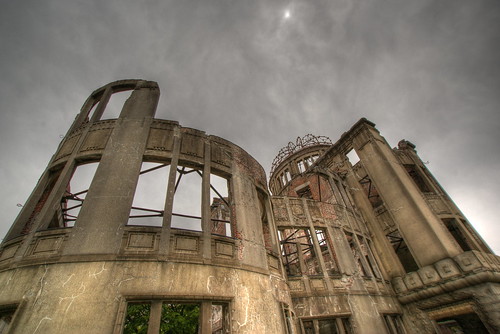
The building above is called the Atomic Bomb Dome, and it’s on World Heritage List.  At the time of the bombing at 8:15am on 6 August 1945, it was the pride and joy of Hiroshima, a beautifully designed regional trade hall.  The A-bomb exploded 600 meters almost directly above.  Since the incredible pressure and blast came from directly overhead, it was one of the few buildings to stay standing within two kilometers.  All the occupants of the building were instantly killed by the intense heat, along with 80,000 in the surrounding area.  By the end of 1945, 140, 000 would be dead.


INDIA AND PAKISTAN
THE NUCLEAR SHADOW


I tried. It was all a nightmare - my wounds, the darkness, the road ahead. My movements were ever so slow; only my mind was running at top speed.

In time I came to an open space where the houses had been removed to make a fire lane. Through the dim light I could make out ahead of me the hazy outlines of the Communications Bureau's big concrete building, and beyond it the hospital. My spirits rose because I knew that now someone would find me; and if I should die, at least my body would be found. I paused to rest. Gradually things around me came into focus.


Wednesday, November 10, 2010

WELCOME TO INDIA, OBAMA SAHIB


by Eric Margolis


Getting out of the Washington goldfish bowl is also good for American presidents, particularly after an electoral shellacking.

It must have been a relief for President Barack Obama to see smiling Indian officials on his visit to Delhi rather than snarling Republicans back home.
India is a hugely important nation by any measure, so it was right for the president to continue the Washington-Delhi dialogue begun by former President George W. Bush.
After six decades of hostility and distrust, the United States and India appear set on a course of warm relations and strategic cooperation.
One million talented Indians already live in the United States, with many more to come. They already play an important fundraising role in US politics.
The catalyst for US-Indian amity was the 9/11 attacks that shocked the US and India into an alliance of convenience against foes in the Muslim world. But the looming threat of China, and Pakistan’s nuclear arsenal that worried Israel, also played a key role. To Republican strategists, the most obvious way to contain China’s growing power was to build up its great rival India as a counterweight.

India is now the latest international Klondike. Its $1,070 trillion economy, freed of oppressive government regulations know as the “license Raj,” is booming at over 8% annual growth while the US has a mostly negative image around the globe, it is wildly popular in India.
US arms makers and high-tech industries are salivating at the thought of entering India’s market. India’s rapidly expanding military forces need modern equipment and replacement for aging Soviet-supplied weapons systems. America’s military-industrial-financial complex pushed Bush hard to make nice to India and pry open its formerly sealed gates. The pressure continued on Obama who dutifully continued Bush’s Indian policies.
However, some perspective is in order. The GDP of 1.2-billion person India is still only half of that of Italy. Forty percent of India’s 1.2 billion people subsist below even that nation’s dire poverty level. Almost half have no indoor plumbing. Childhood malnutrition and child labor are rampant. India’s evil caste system remains entrenched in spite of government efforts to uproot it, a racist system that condemns darker skinned Indians to a life of penury and servitude.
While the western media fulminates against Taliban’s or Iran’s treatment of women, a leading British medical journal reports an estimated 40,000 Indian women are burned alive each year by their in-laws to grab their dowries. Infanticide of female children is endemic. But few in the west seem to care.
India is a giant with feet of clay. A senior western diplomat in unhealthy Delhi told me that at any given time, half his staff is ill with serious maladies. India is plagued by grave health and environmental problems.
India is really two nations: modern, dynamic, high-tech urban India of about 100 million, and antique, timeless rural Mother India of 1.1 billion souls. The two are often in conflict and uneasily coexist. Per capita income is about $1,050, up 10% in 2010. By contrast, per capita income in rival China is three times higher – provided we believe Beijing’s statistics.
To China’s annoyance, President Obama proclaimed in Delhi that India should have a permanent seat on the UN Security Council. India is becoming a great power and deserves a seat among the world’s big boys. But so do Germany, Japan, Turkey and Brazil.
India and its people, long disparaged by British racist jokes, are delighted to be called equals by the great powers. In fact, nuclear-armed India sees itself very much as regional hegemon of the entire Indian Ocean extending from East Africa to Australia.
The Bush administration’s deal with Delhi to sanctify and facilitate India’s nuclear weapons programs was thought at the time a clever move. But it dismayed the rest of the world, made a mockery of non-proliferation, and outraged the entire Muslim world, which has been blasting the US for hypocrisy by threatening war against Iran, which is under UN nuclear inspection, while playing nuclear footsie with India, which rejected all UN inspection.
India’s leaders are no fools and will not be easily pushed or bribed into a stronger anti-China and anti-Iran stance by Washington – unless doing so suits Delhi. India needs oil from the Gulf even more than the US and is expanding its naval power to assure its supply lines.
Delhi maintains cool but correct relations with Beijing, but behind the wintry, trans-Himalayan smiles lies growing rivalry over Chinese-occupied Tibet, Indian-ruled Ladakh and Kashmir, their long, poorly demarcated Himalayan border (another gift of the British Empire), strategic Burma, and their intensifying nuclear and naval rivalry.
India claims China is trying to surround it, using Pakistan, Sri Lanka, Bangladesh, and Burma. The two Asian superpowers have been locked in a strategic and conventional arms race for a decade. In 1999, this writer postulated that the two giants would one day clash over their contested borders.
India will follow its own strategic and diplomatic interests – which are not synonymous with those of the United States.
Delhi has a long record of clever diplomacy that has isolated Pakistan and kept the world and UN out of the burning Kashmir problem, where 40,000–80,000 Kashmiris have died in a long independence struggle against Indian rule.
But the United States is now slowly being drawn into the dangerous Kashmir dispute – which triggered the 2008 terror bombing in Mumbai. Just look for example at the embarrassing revelations that one of the men involved in the 2008 Mumbai massacre was working for the US Drug Enforcement Agency.
The more Washington backs and arms India, the more its relations with China will deteriorate. Japan is also quietly building up India against China, to Beijing’s mounting anger.
The US could even be drawn into an India-China regional conflict. So caution is advised to US diplomats as they charge into the murky, tangled, poorly understood geopolitics of South and East Asia.
We also wonder if President Obama was briefed on India’s growing strategic arsenal. India has been steadily developing a family of long-ranged intercontinental ballistic missiles that can carry nuclear warheads behind the cover of space-launcher vehicles.
Delhi already has enough medium-ranged Agni-series missiles to cover potential foe China. Why then is Delhi spending billions to develop a reported 12,000 km ICBM whose only targets could be North America, Europe or Australia?
India is also developing nuclear submarines and subs armed with nuclear-armed cruise missiles capable of striking distant targets, as well as the powerful BrahMos anti-ship missile whose primary function is to attack aircraft carriers and large warships. Only the US Navy operates such large vessels in the Indian Ocean. India is also intent on building more aircraft carriers to project power.
The US and India appear destined to become rivals for Mideast and Central Asian oil and influence. There is no guarantee that today’s bonhomie between Delhi and Washington will be permanent. Great powers have their special interests – and no permanent friends or enemies.
Euphoria over the new US-Indian love-in should not cloud our judgment of South Asia’s realities, nor make us believe we can cajole India into becoming a regional policeman for US interests.
Meanwhile, Pakistan, Washington’s vital ally in the failing Afghan War, is seething with ill-concealed fury over Obama’s Delhi love-in and his claim that India has an important role to play in Afghanistan – which Pakistan sees as its strategic backyard.
South Asia is a minefield. Caution, and more caution, is advised.
(Eric S. Margolis is an award-winning, internationally syndicated columnist. His articles appear in the New York Times, the International Herald Tribune, the Los Angeles Times, Times of London, the Gulf Times, the Khaleej Times and other news sites in Asia).
_______
Source: There are no sunglasses
Disclaimer: The views expressed in this article are the sole responsibility of the author and do not necessarily reflect those of the ‘Wonders of Pakistan’. The contents of this article too are the sole responsibility of the author(s). WoP will not be responsible or liable for any inaccurate or incorrect statements contained in this post.
YOUR COMMENT IS IMPORTANT
DO NOT UNDERESTIMATE THE POWER OF YOUR COMMENT
Wonders of Pakistan supports freedom of expression and this commitment extends to our readers as well. Constraints however, apply in case of a violation of WoP Comments Policy. We also moderate hate speech, libel and gratuitous insults.


PAKISTAN AND INDIA UNDER THE NUCLEAR SHADOW page 2 of 3


A girl prays for the atomic bomb victims in the Peace Memorial Park in Hiroshima, Japan August 5, 2007 as the city marked the 62nd anniversary of the world's first atomic bombing on August 6, 1945. Photo Reuters


INDIA AND PAKISTAN 
THE NUCLEAR SHADOW


I have taken these paragraphs mainly from a book by Dr. Ch. Jamil Anwar. The book is titled ‘Atom Bomb: The Concept and Reality’. The book intends to trace down the history of atom bomb. I wonder how Dr. Jamil has been able to describe a purely scientific matter in such an elucidating, full of interest and sensational style that even I, a student of Urdu literature was so completely absorbed in the book. I didn’t leave the book till such time that I had finished it from beginning to end.
But the particular part of the book that completely gripped me, was the one where the author describes the story of barbarism committed by the modern day hero of global war on terror, the United States of America, a hero that turns hundreds and thousands of innocent persons in the two Japanese cities into mere ash and then ‘celebrates’ this ‘men into ashes’ festivity, a festivity that makes one’s skins to crawl.
The author deserves credit for his moving style. While reading his book I felt as if I was myself a witness to this most tragic, most barbaric act in human history. His style of describing things is so absorbing that I felt I was Dr. Michihiko Hachiya myself who surprisingly came alive from the inferno called Hiroshima.

What happened to Dr. Michihiko let’s listen from his own mouth:

I have taken these paragraphs mainly from a book by Dr. Ch. Jamil Anwar. The book is titled ‘Atom Bomb: The Concept and Reality’. The book intends to trace down the history of atom bomb. I wonder how Dr. Jamil has been able to describe a purely scientific matter in such an elucidating, full of interest and sensational style that even I, a student of Urdu literature was so completely absorbed in the book. I didn’t leave the book till such time that I had finished it from beginning to end.
But the particular part of the book that completely gripped me, was the one where the author describes the story of barbarism committed by the modern day hero of global war on terror, the United States of America, a hero that turns hundreds and thousands of innocent persons in the two Japanese cities into mere ash and then ‘celebrates’ this ‘men into ashes’ festivity, a festivity that makes one’s skin to crawl.
The author deserves credit for his moving style.
While reading his book I felt as if I was myself a witness to this most tragic, most barbaric act in human history. His style of describing things is so absorbing that I felt I was Dr. Michihiko myself who surprisingly came alive from the inferno called Hiroshima.
What happened to Dr. Michihiko let’s listen from his own mouth:

Suddenly, a strong flash of light...

"The hour was early; the morning still, warm, and beautiful. Shimmering leaves, reflecting sunlight from a cloudless sky, made a pleasant contrast with shadows in my garden as I gazed absently through wide-flung doors opening to the south.

Clad in drawers and undershirt, I was sprawled on the living room floor exhausted because I had just spent a sleepless night on duty as an air warden in my hospital.
Suddenly, a strong flash of light startled me - and then another. So well does one recall little things that I remember vividly how a stone lantern in the garden became brilliantly lit and I debated whether this light was caused by a magnesium flare or sparks from a passing trolley.
Garden shadows disappeared. The view where a moment before had been so bright and sunny was now dark and hazy. Through swirling dust I could barely discern a wooden column that had supported one comer of my house. It was leaning crazily and the roof sagged dangerously.

Moving instinctively, I tried to escape, but rubble and fallen timbers barred the way. By picking my way cautiously I managed to reach the roka [an outside hallway] and stepped down into my garden. A profound weakness overcame me, so I stopped to regain my strength. To my surprise I discovered that I was completely naked How odd! Where were my drawers and undershirt?

What had happened?

All over the right side of my body I was cut and bleeding. A large splinter was protruding from a mangled wound in my thigh, and something warm trickled into my mouth. My cheek was torn, I discovered as I felt it gingerly, with the lower lip laid wide open. Embedded in my neck was a sizable fragment of glass which I matter-of-factly dislodged, and with the detachment of one stunned and shocked I studied it and my blood-stained hand.

Where was my wife?

Suddenly thoroughly alarmed, I began to yell for her: 'Yaeko-san! Yaeko-san! Where are you?' Blood began to spurt. Had my carotid artery been cut? Would I bleed to death? Frightened and irrational, I called out again 'It's a five-hundred-ton bomb! Yaeko-san, where are you? A five- hundred-ton bomb has fallen!'

Yaeko-san, pale and frightened, her clothes torn and blood stained, emerged from the ruins of our house holding her elbow. Seeing her, I was reassured. My own panic assuaged, I tried to reassure her.
'We'll be all right,' I exclaimed. 'Only let's get out of here as fast as we can.'

She nodded, and I motioned for her to follow me."

It was all a nightmare...

Dr. Hachiya and his wife make there way to the street. As the homes around them collapse, they realize they must move on, and begin their journey to the hospital a few hundred yards away.

After the Blast
"We started out, but after twenty or thirty steps I had to stop. My breath became short, my heart pounded, and my legs gave way under me. An overpowering thirst seized me and I begged Yaeko-san to find me some water. But there was no water to be found. After a little my strength somewhat returned and we were able to go on.

I was still naked, and although I did not feel the least bit of shame, I was disturbed to realize that modesty had deserted me. On rounding a corner we came upon a soldier standing idly in the street. He had a towel draped across his shoulder, and I asked if he would give it to me to cover my nakedness. The soldier surrendered the towel quite willingly but said not a word. A little later I lost the towel, and Yaeko-san took off her apron and tied it around my loins.

Our progress towards the hospital was interminably slow, until finally, my legs, stiff from drying blood, refused to carry me farther. The strength, even the will, to go on deserted me, so I told my wife, who was almost as badly hurt as I, to go on alone. This she objected to, but there was no choice. She had to go ahead and try to find someone to come back for me.

Yaeko-san looked into my face for a moment, and then, without saying a word, turned away and began running towards the hospital. Once, she looked back and waved and in a moment she was swallowed up in the gloom. It was quite dark now, and with my wife gone, a feeling of dreadful loneliness overcame me.

I must have gone out of my head lying there in the road because the next thing I recall was discovering that the clot on my thigh had been dislodged and blood was again spurting from the wound.

I pressed my hand to the bleeding area and after a while the bleeding stopped and I felt better

Could I go on?
_____ 


Contd..
Page 1 2 3 Next 


YOUR COMMENT IS IMPORTANT
DO NOT UNDERESTIMATE THE POWER OF YOUR COMMENT
Wonders of Pakistan supports freedom of expression and this commitment extends to our readers as well. Constraints however, apply in case of a violation of WoP Comments Policy. We also moderate hate 


Pakistan and India under the Nuclear Shadow page 1 of 3


INDIA AND PAKISTAN
THE NUCLEAR SHADOW

Note for WoP readers: My current post is based on a column in Urdu. The writer has been one of those op-editors of a daily whom I have been reading since my youth. [In those days he used to write for Nawai Waqt which was the leading Urdu daily in this part of Pakistan. I don’t know how does it rank now vis-à-vis Jang but in those days it was the leading daily indeed]. Ever since I started reading his first column in Nawai Waqt I almost got addicted to it. In particular what I always loved in his writing has been his style especially for the Punjabi words which he incorporates so beautifully in his “salees” Urdu that they almost become natural part of his Urdu writings. Another aspect which endears me to his columns is that special touch of humor he so articulately puts into his writing.  Nowadays when we mostly read almost every other day news on drone bombings, suicide attacks, load shedding, sugar shortages and other such horrible things, he brings us every morning  something which sometimes makes you smile and many time makes you burst into a laughter.
But his present column is quite opposite to what he normally writes. It’s a very serious and indeed a highly dangerous matter too. However, instead of me taking you further into what he thinks on this, I would suggest you directly reach his column and think again some thing. [See for yourself], is it really that unthinkable? [Nayyar]

Ata-ul-Haq Qami is a noted Urdu columnist. In one of his recent column, he writes:
“Its 6th of August 1945. After a successful bombing of Japanese industrial city and a principal military town [Hiroshima] Enola Gay has safely landed at the Tinian airbase. A large gathering has assembled to greet the plane crew. Included in the gathering are Gen.’s Spaatz and Lemay.
Right: Bust of Gen.Carl Andrew Spaatz, the US General and the first Chief of Staff of the United States Air Force. (Source: Wikipedia 
On 11th of March, 1945 Spaatz assumed command of the U.S. Strategic Air Forces in the Pacific as part of the Pacific Theatre of Operations. It was from this command, in July 1945 that Spaatz directed the strategic bombing of Japan, including the atomic bombing of Hiroshima and Nagasaki.
       
Curtis Emerson LeMay was also a general of the United States Air Force. He is credited with designing and implementing an effective, but also controversial, systematic strategic bombing campaign in the Pacific theater of World War II. During the war, he was known for planning and executing a massive bombing campaign against cities in Japan. After war, he reorganized the Strategic Air Command (SAC) into an instrument of nuclear war Source: Wikipedia 
A ceremony is held to celebrate the successful attack on Hiroshima. Col Paul Tibbets who led the Gay mission and piloted the plane is decorated with a medal. Gen. Spaatz eulogizes the services of the Gay crew. President Harry S. Truman who is on board the USS Augusta on his way from Potsdam to Washington gets the news while on ship. The president speaks to sailors. His face is gleaming with joy. “We should reach America as soon as possible. This is a great moment in history”, says the president.
The president was of course right, for prior to Hiroshima bombing, the history never had seen such a ‘great’ moment in history; of wanton barbarism on humanity on such a vast scale.

The same evening the White House issued a press release which described the making of the atom bomb as a great success in the history and that it was the US that had achieved that unique and solitary success. The first bomb had been dropped on a Japanese city Hiroshima. Now if Japan didn’t surrender, said the press release, it would face a rain of ruin from the skies that would have no parallel in history.

Let us see now how this day the 6th of August, 1945 the city looked like:
The sun rose into a clear blue sky over the city of Hiroshima, promising a warm and pleasant day. Nothing in the day's dawning indicated that this day would be any different from its predecessors. But this day would be different, very different. This day would change the world. On this day a single bomb dropped by a single airplane would destroy the city, leading to the end of World War II and introducing mankind to the Atomic Age.
At 8:15 a.m. local time, the Enola Gay dropped Little Boy onto Hiroshima. Just 43 seconds later it exploded 1,900 feet above the city.Then the brilliant morning sunlight was slashed by a more brilliant white flash.From the men who had rung up the curtain on a new era in history burst nothing more original than an awed ‘My God!,’” wrote Time.

Nearly five square miles, over 60 percent of the developed city, was destroyed. “All around, I found dead and wounded,” described one Japanese official. “Some were bloated and scorched—such an awesome sight, their legs and bodies stripped of clothes and burned with a huge blister. All green vegetation, from grasses to trees, perished in that period.”
“I cannot bear to see my innocent people suffer any longer,” declared Emperor Hirohito before the Japanese Supreme Council. “Ending the war is the only way to restore world peace and to relieve the nation from the terrible distress with which it is burdened.”
Continued...Page 2 3 Next

YOUR COMMENT IS IMPORTANT
DO NOT UNDERESTIMATE THE POWER OF YOUR COMMENT
Wonders of Pakistan supports freedom of expression and this commitment extends to our readers as well. Constraints however, apply in case of a violation of WoP Comments Policy. We also moderate hate

Search

Custom Search