Showing posts with label USA. Show all posts

Tuesday, December 14, 2010

Was Pakistan embassy really used for anti-Iran dinner?


Pakistani Ambassador hosting fundraiser for neocon think-tank?


If this had not come from a reliable source, the readers would treat it as a joke of the century. It sounds incredible that an  ambassador of a country being ruled by the world’s shrewdest president was fooled; and that too by a Neocon think tank for their fund-raising.  According to the Middle East Channel, the Pakistani ambassador to the U.S. hosted a fundraiser at his residence for a neoconservative D.C. think-tank, which solicited donations of $5,000 for invitations to the event. But the think-tank, thFoundation for Defense of Democracies (FDD), didn’t bother to tell the Pakistani embassy that the event was a fundraiser or that it was sandwiched in the middle of a two-and-a-half day conference on Countering the Iranian Threatput on by the group.

“We didn’t know at all that they have done this fund-raising,” a spokesperson for the Pakistani embassy, told the Middle East Channel. “And neither did they share with us that they would be doing this conference. Very frankly, we didn’t know about this conference.”

----

 Though the dinner appeared in the paper and online conference programs, FDD president Cliff May insisted that the two were unrelated: “The dinner was separate from the conference but it coincided with the conference. Why? Because many friends of FDD were in town for the conference,” he wrote in an e-mail to the Middle East Channel. May conceded that his staff may have failed to notify the Pakistani embassy that the group was in the middle of hosting the conference.

At the “Washington Forum, “as the conference was called, fellows and scholars from FDD advocated for escalating measures against the Islamic Republic of Iran, ranging from “ratcheting up” sanctions and pressure to U.S. support for regime change and even military strikes against Iran.  The location of the fundraiser — billed on the program as only “dinner at the residence of one of Washington‘s noteworthy Ambassadors” — was a closely guarded secret on the first full day of the event. FDD’s communications director, Judy Mayka, told the Middle East Channel on Wednesday night before the dinner that even she didn’t know where it would be held.

As the conference’s second full day drew to a close, Middle East Channel reports, May confirmed that the dinner had been at the Pakistani ambassador’s residence and said that between forty and fifty people were at the dinner. But the embassy spokesperson, emphasized that Iran was not an issue during the dinner. May disputed that the event was a fundraiser, telling the Middle East Channel that “friends and supporters” were invited, and that there was no “quid-pro-quo” relationship between a $5,000 donation and an invitation. “I invited FDD donors at or above the $5,000 level to the event,” May wrote in a follow-up interview by e-mail. “Others friends of FDD were invited — at my discretion. Several FDD staff members were invited as well.”
But the online conference schedule, which didn’t name the ambassador in question, left little room for equivocation:
7:00 pm
Dinner at the residence of one
of Washington’s noteworthy Ambassadors
(Closed to Media)
(Minimum $5,000 gift required. Contribute here, or for more information on becoming a donor, please contact [e-mail of FDD staffer removed])
The paper version of the schedule handed out to conference participants only said: “Dinner at the residence of one of Washington’s ambassadors — Will leave from the Ritz-Carlton Hotel. See staff for more details.”

The Pakistani press attache, Nadeem Hotiana, said the dinner “was in honor of (FDD), but the participants were donors.” He added that no donations were collected on the premises.

May described Haqqani as an “old personal friend,” a relationship corroborated by Shuja Nawaz, the director of the Atlantic Council‘s South Asia Center. “I think the ambassador had a personal relationship with this group for quite some time,” Nawaz said, “but I don’t know if this would reflect official policy. It could well be that this is an unofficial action on his part.”

Indeed, while Iran and Pakistan more or less waged a proxy war in Afghanistan in the 1990s — when Iran supported the Northern Alliance until the Pakistani-supported Taliban took power nationally — the countries enjoy good relations. “I would characterize their relations as cordial — not warm at all times, but for the most part cooperative on issues like building a pipeline through Pakistan,” said Alireza Nader of the RAND Corporation.
Nawaz of the Atlantic council said the issues between the countries revolve around Jundullah, a Balochi rebel group on the border that says it fights for Iran’s Sunni minority that Iran alleges seeks refuge in Pakistan, and Iran’s collaboration with Pakistan’s archrival India to build a road from Afghanistan to a port town in Iran that bypasses Pakistan.

“But they’ve always maintained good relations on the surface,” said Columbia University professor and Iran expert Gary Sick. “They try to maintain good, business like relations. Each side will allow a certain amount of trouble from the other because they know they need each other.”

Which makes it curious that a group hosting a conference very much focused on isolating Iran and pushing escalating measures against the Islamic Republic would take refuge in an embassy of a country — Pakistan — so opposed to such policies. Perhaps that’s why both May and the embassy spokesperson, tried to explain away the events. May said the funding links on the conference program — listed under the dinner, with a minimum to attend — was merely a “reminder” for donors to give more, “routine among think tanks.”
For his part, the spokesperson chalked up the mix-up to chance: “We Pakistanis and we Muslims are very courteous people,” he said, explaining why so few questions were asked. ”It was just a coincidence that this happened like this because the Ambassador has his personal friends.”
The writer Ali Gharib is a New York- and Washington-based journalist on U.S.-Iran relations. His work appears at LobeLog.com and you can follow him on twitter @LobeLog. 
---
Source:  fmeducation
Disclaimer: The views expressed in this article are the sole responsibility of the author and do not necessarily reflect those of the ‘Wonders of Pakistan’. The contents of this article too are the sole responsibility of the author(s). WoP will not be responsible or liable for any inaccurate or incorrect statements contained in this post.
YOUR COMMENT IS IMPORTANT
DO NOT UNDERESTIMATE THE POWER OF YOUR COMMENT
Wonders of Pakistan supports freedom of expression and this commitment extends to our readers as well. Constraints however, apply in case of a violation of WoP Comments Policy. We also moderate hate speech, libel and gratuitous insults.


Sunday, December 5, 2010

US Has Taken Over Pakistan–(if only the Pakistanis knew)


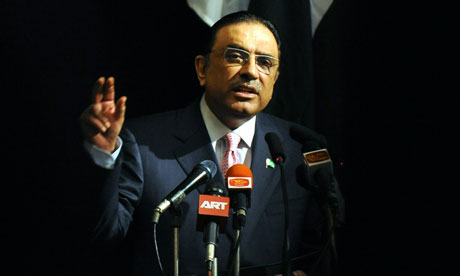
WikiLeaks cables report the rule of President Asif Ali Zardari (above) was constantly under harsh review by the US.


Bob Woodward writes in his book titled Obama’s Wars. On November 12, 2008, then-CIA Director Gen. Michael Hayden disclosed the killings to Pakistani president Asif Ali Zardari during a meeting in New York. At the meeting, Zardari allegedly said, “Collateral damage worries you Americans. It does not worry me.” Of course killings in Fata could never bother the president of the Islamic Republic. Life of the Bilawals of Pakistan carries no value because they are not born to a feudal lord like him. Or may be we Pakistanis are too emotional to react for how could the governor of a satrapy like Pakistan complain something his imperial masters did not wish and let him go beyond what they already ordained for him. Photograph: Ishara S Kodikara/AFP/Getty Images
---

by Simon Tisdall

Pakistan was already under the American hammer before the WikiLeaks crisis blew. But leaked US diplomatic cables published by the Guardian show the extraordinary extent to which Pakistan is in danger of becoming a mere satrapy of imperial Washington.

The US assault on Pakistani sovereignty, which is how these developments are widely viewed in the country, is multipronged. At one end of the spectrum, in the sphere of "hard power", US special forces are increasingly involved, in one way or another, in covert military operations inside Pakistan.

These troops are being used to help hunt down Taliban and al-Qaida fighters in the tribal areas and co-ordinate drone attacks, as revealed by the Guardian's Pakistan correspondent, Declan Walsh. Their activities come in addition to previous air and ground cross-border raids; and to the quasi-permanent basing of American technicians and other personnel at the Pakistani air force base from which drone attacks are launched.

The US hand can be seen at work in Pakistan's complex politics, with the standing and competence of President Asif Ali Zardari seemingly constantly under harsh review. At one point, the military chief, General Ashfaq Kayani, reportedly consults the US ambassador about the possibility of a coup, designed in part to stop the advance of the opposition leader, Nawaz Sharif.
At the same time, Pakistani diplomats are convinced the Americans are somehow trying to commandeer the country's nuclear deterrent, which they see as its only real defence against India. And all this importunity is underpinned by "soft power", by a reverse cash tribute from Washington to Islamabad, approaching $2bn a year. In a very real sense, the Americans buy their way in.
This sort of helpful meddling, or shameless intrigue, or outrageous interference – decide yourself what you want to call it – in the internal affairs of a sovereign country is supposed to have gone out of fashion with the retreat of the British empire and the end of the Raj.

But that was never true in reality, of course. All great powers intrude in pursuit of their own interests; it's what they do – and picking up where the British left off, the US is no different. It is a measure of the Pakistani state's weakness that the Americans apparently have such scope and leeway to influence and direct its affairs.
What is equally remarkable, however, is how little the Americans appear able, ultimately, to control their satraps. Zardari talks a good game but achieves little. Millions of US taxpayer dollars earmarked for fighting Islamist extremists allegedly disappears into government coffers, never to be seen again. Washington's staunch Pakistani allies in the "war on terror" play both sides, maintaining their ties to friendly Taliban and the Lashkar-e-Taiba militant group while simultaneously accepting America's largesse. Being an imperialist is never easy.

So the Americans don't get what they want. But neither do ordinary Pakistanis.

The larger point is that Pakistan is suffering grievously, in terms of lives lost to terrorism; in soldiers and civilians killed and wounded in the campaigns against Pakistani Taliban in the tribal areas; in a ravaged economy, acute poverty and lack of education; and in the all but forgotten but still terrible aftermath of this year's floods.
Pakistan needs less foreign interference, not more.
And that applies to Arab jihadi fanatics as much as it does to imperious Americans. But on current trends the opposite is happening.

The clear danger, highlighted by the leaked cables, is that the west's unwinnable war in Afghanistan is spilling over into its weak, ill-led and much put-upon neighbour – and that Pakistan, too, could become a war zone.
Disclaimer: The views expressed in this article are the sole responsibility of the author and do not necessarily reflect those of the ‘Wonders of Pakistan’. The contents of this article too are the sole responsibility of the author(s). WoP will not be responsible or liable for any inaccurate or incorrect statements contained in this post.
YOUR COMMENT IS IMPORTANT
DO NOT UNDERESTIMATE THE POWER OF YOUR COMMENT
Wonders of Pakistan supports freedom of expression and this commitment extends to our readers as well. Constraints however, apply in case of a violation of WoP Comments Policy. We also moderate hate speech, libel and gratuitous insults.

Thursday, November 25, 2010

USA, A Kid in a NATO Candy Store...


USA, a kid in a NATO candy store...


by Pepe Escobar


 As clinically on target as a pat-down in a major United States airport, the Pentagon got a fabulous box of chocolates - and then some - from its 27 North Atlantic Treaty Organization (NATO) allies at last weekend's Lisbon summit.

The chocolates come in a full spectrum of flavors.

One: NATO's new "Strategic Concept", complete with European-wide cyber-warfare subordinated to a "meet the old boss, same as the old boss" pattern - the Pentagon's new Cyber Command, euphemistically defined as "centralized cyber protection".

Two: The promise of the whole of Europe - in theory - enveloped by a missile defense dome ("missile defense will become an integral part of our overall defense posture").

Three: US tactical nuclear weapons indefinitely stationed in five bases scattered across European soil.

Four: 20 NATO "partners" still shelling out troops for the Afghan war for, well, forever. (At least the Lisbon-summit declaration did not beat around the bush: "Transition will be conditions-based, not calendar-driven, and will not equate to withdrawal of ISAF [International Security Assistance Force] troops.")


NATO has also acquired what seems to be a new missile-defense "partner" all across Eurasia - from the Baltic to the Pacific Ocean: Russia. But contrary to the Western corporate-media narrative, Russia has only agreed to a study of "possible" missile threats and to engage in a vague "dialogue" before a possible joint decision by defense ministers from NATO countries in June 2011.


The Pentagon/NATO Star Wars remake has been relentlessly spun as defense against a highly hypothetical full-scale ballistic missile attack by either Iran or North Korea. Even assuming this is not a Marvel Comics stunt, such a system would rely on Airborne Warning and Control Systems, which even a moderately skilled hacker could jam. And all this assumes that the respective leaderships of "axis of evil" members Iran and North Korea are in the business of committing seppuku - ritual suicide.

So, essentially, the "dome" is a public-relations myth. But if this Star Wars remake is interpreted as a sort of large-scale improvised explosive device conceived to "contain" strategic competitor China in a not-so-distant future, then the script gets much juicier.

A PRODIGY OF INTELLIGENCE

NATO pledged to hand over security in Afghanistan to Afghans by the end of 2014. But, just in case, it also pledged to keep occupying it indefinitely. Even 2014 (anybody remember 2011?) is an "aspirational" goal, according to Pentagon spokesman Geoff Morrell. As to how many US/NATO troops will be getting a piece of the action from 2015 onwards, that's a classic example of one of former US defense secretary Donald Rumsfeld's "known unknowns".

As far as a "known known" goes, nothing beats the Fake Mullah Dude gambit.

A diplomat told the New York Times that Mullah Akhtar Muhammad Mansour, the alleged number two to invisible Taliban leader Mullah Omar involved in discussions with the Karzai government, is not the real mullah: he is a fake. General David Petraeus had to run to the rescue - if not for cover - saying that the Pentagon suspected something was off. NATO was involved in the discussions - which have been going on for a few months now. The fake mullah did not fail to bag a lot of cash in the process. And obviously Mullah Omar's gang in Quetta must be laughing their turbans off.

Once again, NATO's fabled multilingual skills don't mean that you can dust up your Polish when you need to think in Pashto. File this one as another spectacular triumph of Pentagon/NATO intelligence.

NATO's self-described "mission" since 2001 has been to fight against "international terrorism". Even low-level Central Intelligence Agency operatives know there are no "al-Qaeda" in Afghanistan, apart from 20 or 30 invisible jihadi trainers. So this war is not about al-Qaeda.

On the other hand, Pashtuns  comprise 42% of Afghanistan's population.

NATO is attacking anyone from the Gulbuddin Hekmatyar faction to the Jalaluddin Haqqani network, and all the disgruntled tribal guerrilla factions in between. The Pentagon/NATO "strategy" has been essentially to take out mid-level Taliban or guerrilla commanders. Problem is, most are Pashtun tribal leaders. Inevitably their tribes rebel en masse, be they Taliban-affiliated or not, and vow to kill the invaders. The bottom line: Afghanistan is nothing but a Western war against Pashtuns.

In yet one more spectacular PR failure, Pentagon/NATO even forgot to inform the Pashtuns about it. A report by an International Council on Security and Development (ICOS) think tank has just showed that 92% of Pashtuns in Helmand and Kandahar provinces know absolutely nothing about 9/11. The report noted that the "relationship gap" between Afghans and the "international community" was "dramatic". File this one as understatement of the decade.

So a bunch of angry Pashtuns are in fact the ultimate threat to NATO and its global, non-stop expansionist drive from the Balkans to the former Soviet Union - instilling supreme fear in NATO's 36 divisions, 120 brigades, 11,000 tanks, 23,000 artillery pieces and 4,500 fighter jets (and that's only what's stationed in Europe).

If NATO is scared to death of Pashtuns, imagine when it turns its attention to the nomadic Tuareg - the indigenous population of most of central Sahara and the Sahel, with impressive numbers in the north of both Niger and Mali. In the current, concerted Western campaign to define them as pawns of "evil" al-Qaeda in the Maghreb (AQIM), NATO should be warned that the Tuareg can be every bit the bad asses that the Pashtuns are. God help the white man's burden.

NATO did make a deal with Moscow to send logistical support to Afghanistan through Russia - and not Pakistan. That does put Islamabad on the spot. Next time Washington won't even ask permission to ramp up the drone war. In fact, this game is already on.

The operative mood now is not only bomb the tribal areas (especially after the Haqqani network scattered northwards, from North Waziristan to Kurram); it is also bomb Quetta, Balochistan's capital - where Taliban leader Mullah Omar may be hiding (and laughing his turban off).

Pakistan's Ministry of Interior duly denies everything - even as the CIA and Pakistan's Inter-Services Intelligence "increase their cooperation". So one should expect major upcoming "collateral damage" in and around Quetta; and the Balochistan separatist movements will be having a ball. The bottom line: real men go to Quetta.

THE WAR BOUTIQUE

Whatever the drama quotient involved, one may be certain that NATO's nuclear/cyber-warfare/missile defense embrace will be striving to include the whole white world.
As the Lisbon summit declaration proclaimed: "The promotion of Euro-Atlantic security is best assured through a wide network of partner relationships with countries and organizations around the globe." Translation: Europe, apart from posing as an oversized boutique seducing the Asian consuming hordes, now exists primarily as a forward operating base for war around the globe.

In fact, the US, NATO and the European Union are now on the way to becoming essentially the same entity - as in the president of the EU's European Council, faceless Belgian bureaucrat Herman Van Rompuy, telling NATO leaders in Lisbon: "The ability of our two organizations to shape our future security environment would be enormous if they worked together. It is time to break down the remaining walls between them." Pashtuns of the world unite; if you keep rocking, these walls will definitely crumble.
----
Disclaimer: The views expressed in this article are the sole responsibility of the author and do not necessarily reflect those of the ‘Wonders of Pakistan’. The contents of this article too are the sole responsibility of the author(s). WoP will not be responsible or liable for any inaccurate or incorrect statements contained in this post.

YOUR COMMENT IS IMPORTANT
DO NOT UNDERESTIMATE THE POWER OF YOUR COMMENT
Wonders of Pakistan supports freedom of expression and this commitment extends to our readers as well. Constraints however, apply in case of a violation of WoP Comments Policy. We also moderate hate speech, libel and gratuitous insults.


Monday, November 22, 2010

The Cost of Humiliation


This is what the VersaillesTreaty was for the Germans. The French [the victors] in order to ensure that Germany did not attack France again, humiliated the defeated, incorporating harsh provisions in the armistice document. But it was a stupid way to do things."The Second World War took place not so much because no one won the WWI, but because the Versailles did not acknowledge this truth."


Note for WoP readers: There are innumerous examples of the cost of humiliation. Americans humiliated at the hands of the British when United States used to be a colony of the former. French humiliated at the hands of the Germans and then Germans themselves humiliated at Versailles. Back home peoples of the subcontinent at the hands of their British colonial masters.
In 1962 the Indians at the hands of the Chinese and Pakistanis during the 1971 war at the hands of Indians. But what we need to learn is that cost of humiliation is always much greater than the advantages reaped out of victories in the war.
It makes me recall one incident the late Altaf Gohar once related in one of his columns. It was narration of his visit to a jail as deputy commissioner in the Punjab.  A chaudhary who was serving his term in the jail, was as usual provided a “mushaqqati” a servant or assistant sort of thing. Th mushaqqati too was a convict [a so called low class, kammi, who by the dint of providence are borne to serve the chaudharys and die in the service of their chaudharys] and too was serving his sentence in the jail.
Every day the chaudhary used to order the mushaqqati to render personal service to him including a massage of chaudhary’s tired limbs. The poor mushaqqati used to serve his master as and when the later liked. It was usual that the chaudhary would order and the mushaqqati like a robot will serve his boss, without any objection, any reservation, any protest, any pretext. To say no or to think of any such reaction was unconceivable as it was his muqaddar to be in the service of a chaudhary even in a jail. But one day when the same chaudhary ordered this mushaqqati to press his feet, the mushaqqati pleaded, he had fever and therefore he himself was unable to do any service. For chaudhary it was intolerable to listen a no from a mushaqqati of lower order, the low caste and kammi, how dare did he ever say no to him. Hence again ordered the mushaqqati.
The latter again pleaded the chaudhary to spare him for that single day as he was not feeling well. But the chaudhary was in no mood to listen a no from a kammi. He again ordered but again came the same reply. Three continuous refusals from the kammi prisoner were enough for the chaudhary, so in a bout of intense rage, the chaudhary took a scoop of filth in his hand from the nearby sewer drain and threw in a nu, all filth, the garbage on the face of the poor sick mushaqqati.
No sooner that it happened, than the mushaqqati said to the chaudhaery “Chaudhary ji, iñj naeeñ si karna” [you should never have done this]. Humiliated, the docile, ever faithful, obedient to the core, the mushaqqati took a knife from his waist band and killed the chaudhaary there and then. Such is the cost of humiliation – for individuals, for communities, the tribes, the nations and for states as well. But the biggest and unfortunate lesson of history is that no one ever learns from history and the cost!  ever more wars, ever more humiliations and still more wars. [Nayyar] 


The Cost


of Humiliation


by Deepak Tripathi


Never underestimate the cost of humiliation. For in war victory is never clean, because it empowers the vanquished, or their successors, to struggle in the future. Recent wars in Iraq, on the Afghanistan-Pakistan front and elsewhere confirm this enduring, though often unheeded, lesson of history. From Alexander the Great, the king of the Macedonian Empire, nearly two-and-a-half millennia ago to date, imperial powers far afield have sent their rampaging armies to conquer and to humiliate the populations of vast fertile lands, cradles of civilization, close to the four great rivers, the Nile, the Euphrates, the Indus and the Hwang He. What transpired forms a pattern.

They include modern Iran, Iraq, Afghanistan and the South Asian subcontinent, Pakistan and India in particular. Amid the extreme volatility in this region there has existed something consistent throughout the last two-and-a-half thousand years and before. Alexander’s campaign of conquest finally ran out of steam on the banks of the Hydaspes, modern-day Jhelum river. His rampaging troops became exhausted. They mutinied, refusing to march any further.

Elsewhere, clans in the Kunar and Swat valleys had put up extraordinary resistance, forewarning one of history’s greatest military geniuses. However, the message from those uprisings was not enough for Alexander to overcome his own hubris. After the Battle of Hydaspes, he retreated to Persia, leaving governors he appointed in charge. But they misbehaved. Alexander was exhausted, injured, his aura not the same. He became even more brutal. He retreated to Persia and died three years after. A remark attributed to Alexander: “I am dying from the treatment of too many physicians.”

The hills and valleys of Swat and Kunar, together with vast surrounding landscapes, have been subjected to repeated invasions through centuries.

Today the soil is soaked in blood spilled in violence between invaders and defenders, communities and tribes, whose fortunes and failings have attracted eagle-eyed predators far and near. And the ground is fertile for agriculture as it is for resistance. Foreign armies have found this to their detriment time after time.

Imperial Britain learned this in the First Anglo-Afghan War (1839–1842) at the onset of the Great Game with Russia for influence in Central Asia, and in two subsequent wars (1878–1880 and 1919) in which the imperial armies suffered heavy losses. In the Third Anglo-Afghan War of 1919, the Afghans wrested control of foreign affairs from the British, and their country became truly independent.

Wednesday, November 10, 2010

WELCOME TO INDIA, OBAMA SAHIB


by Eric Margolis


Getting out of the Washington goldfish bowl is also good for American presidents, particularly after an electoral shellacking.

It must have been a relief for President Barack Obama to see smiling Indian officials on his visit to Delhi rather than snarling Republicans back home.
India is a hugely important nation by any measure, so it was right for the president to continue the Washington-Delhi dialogue begun by former President George W. Bush.
After six decades of hostility and distrust, the United States and India appear set on a course of warm relations and strategic cooperation.
One million talented Indians already live in the United States, with many more to come. They already play an important fundraising role in US politics.
The catalyst for US-Indian amity was the 9/11 attacks that shocked the US and India into an alliance of convenience against foes in the Muslim world. But the looming threat of China, and Pakistan’s nuclear arsenal that worried Israel, also played a key role. To Republican strategists, the most obvious way to contain China’s growing power was to build up its great rival India as a counterweight.

India is now the latest international Klondike. Its $1,070 trillion economy, freed of oppressive government regulations know as the “license Raj,” is booming at over 8% annual growth while the US has a mostly negative image around the globe, it is wildly popular in India.
US arms makers and high-tech industries are salivating at the thought of entering India’s market. India’s rapidly expanding military forces need modern equipment and replacement for aging Soviet-supplied weapons systems. America’s military-industrial-financial complex pushed Bush hard to make nice to India and pry open its formerly sealed gates. The pressure continued on Obama who dutifully continued Bush’s Indian policies.
However, some perspective is in order. The GDP of 1.2-billion person India is still only half of that of Italy. Forty percent of India’s 1.2 billion people subsist below even that nation’s dire poverty level. Almost half have no indoor plumbing. Childhood malnutrition and child labor are rampant. India’s evil caste system remains entrenched in spite of government efforts to uproot it, a racist system that condemns darker skinned Indians to a life of penury and servitude.
While the western media fulminates against Taliban’s or Iran’s treatment of women, a leading British medical journal reports an estimated 40,000 Indian women are burned alive each year by their in-laws to grab their dowries. Infanticide of female children is endemic. But few in the west seem to care.
India is a giant with feet of clay. A senior western diplomat in unhealthy Delhi told me that at any given time, half his staff is ill with serious maladies. India is plagued by grave health and environmental problems.
India is really two nations: modern, dynamic, high-tech urban India of about 100 million, and antique, timeless rural Mother India of 1.1 billion souls. The two are often in conflict and uneasily coexist. Per capita income is about $1,050, up 10% in 2010. By contrast, per capita income in rival China is three times higher – provided we believe Beijing’s statistics.
To China’s annoyance, President Obama proclaimed in Delhi that India should have a permanent seat on the UN Security Council. India is becoming a great power and deserves a seat among the world’s big boys. But so do Germany, Japan, Turkey and Brazil.
India and its people, long disparaged by British racist jokes, are delighted to be called equals by the great powers. In fact, nuclear-armed India sees itself very much as regional hegemon of the entire Indian Ocean extending from East Africa to Australia.
The Bush administration’s deal with Delhi to sanctify and facilitate India’s nuclear weapons programs was thought at the time a clever move. But it dismayed the rest of the world, made a mockery of non-proliferation, and outraged the entire Muslim world, which has been blasting the US for hypocrisy by threatening war against Iran, which is under UN nuclear inspection, while playing nuclear footsie with India, which rejected all UN inspection.
India’s leaders are no fools and will not be easily pushed or bribed into a stronger anti-China and anti-Iran stance by Washington – unless doing so suits Delhi. India needs oil from the Gulf even more than the US and is expanding its naval power to assure its supply lines.
Delhi maintains cool but correct relations with Beijing, but behind the wintry, trans-Himalayan smiles lies growing rivalry over Chinese-occupied Tibet, Indian-ruled Ladakh and Kashmir, their long, poorly demarcated Himalayan border (another gift of the British Empire), strategic Burma, and their intensifying nuclear and naval rivalry.
India claims China is trying to surround it, using Pakistan, Sri Lanka, Bangladesh, and Burma. The two Asian superpowers have been locked in a strategic and conventional arms race for a decade. In 1999, this writer postulated that the two giants would one day clash over their contested borders.
India will follow its own strategic and diplomatic interests – which are not synonymous with those of the United States.
Delhi has a long record of clever diplomacy that has isolated Pakistan and kept the world and UN out of the burning Kashmir problem, where 40,000–80,000 Kashmiris have died in a long independence struggle against Indian rule.
But the United States is now slowly being drawn into the dangerous Kashmir dispute – which triggered the 2008 terror bombing in Mumbai. Just look for example at the embarrassing revelations that one of the men involved in the 2008 Mumbai massacre was working for the US Drug Enforcement Agency.
The more Washington backs and arms India, the more its relations with China will deteriorate. Japan is also quietly building up India against China, to Beijing’s mounting anger.
The US could even be drawn into an India-China regional conflict. So caution is advised to US diplomats as they charge into the murky, tangled, poorly understood geopolitics of South and East Asia.
We also wonder if President Obama was briefed on India’s growing strategic arsenal. India has been steadily developing a family of long-ranged intercontinental ballistic missiles that can carry nuclear warheads behind the cover of space-launcher vehicles.
Delhi already has enough medium-ranged Agni-series missiles to cover potential foe China. Why then is Delhi spending billions to develop a reported 12,000 km ICBM whose only targets could be North America, Europe or Australia?
India is also developing nuclear submarines and subs armed with nuclear-armed cruise missiles capable of striking distant targets, as well as the powerful BrahMos anti-ship missile whose primary function is to attack aircraft carriers and large warships. Only the US Navy operates such large vessels in the Indian Ocean. India is also intent on building more aircraft carriers to project power.
The US and India appear destined to become rivals for Mideast and Central Asian oil and influence. There is no guarantee that today’s bonhomie between Delhi and Washington will be permanent. Great powers have their special interests – and no permanent friends or enemies.
Euphoria over the new US-Indian love-in should not cloud our judgment of South Asia’s realities, nor make us believe we can cajole India into becoming a regional policeman for US interests.
Meanwhile, Pakistan, Washington’s vital ally in the failing Afghan War, is seething with ill-concealed fury over Obama’s Delhi love-in and his claim that India has an important role to play in Afghanistan – which Pakistan sees as its strategic backyard.
South Asia is a minefield. Caution, and more caution, is advised.
(Eric S. Margolis is an award-winning, internationally syndicated columnist. His articles appear in the New York Times, the International Herald Tribune, the Los Angeles Times, Times of London, the Gulf Times, the Khaleej Times and other news sites in Asia).
_______
Source: There are no sunglasses
Disclaimer: The views expressed in this article are the sole responsibility of the author and do not necessarily reflect those of the ‘Wonders of Pakistan’. The contents of this article too are the sole responsibility of the author(s). WoP will not be responsible or liable for any inaccurate or incorrect statements contained in this post.
YOUR COMMENT IS IMPORTANT
DO NOT UNDERESTIMATE THE POWER OF YOUR COMMENT
Wonders of Pakistan supports freedom of expression and this commitment extends to our readers as well. Constraints however, apply in case of a violation of WoP Comments Policy. We also moderate hate speech, libel and gratuitous insults.


Search

Custom Search