Showing posts with label Indo-Pak Friendship. Show all posts

Saturday, December 11, 2010

Asia’s Biggest Glacier Cracking Thanks To Military Activity


GIANT CRACKS IN SIACHEN: A SERIOUS THREAT TO CLIMATE 


Arshad H. Abbasi 


New satellite images show growing giant cracks forming through the Siachen Glacier, the second longest glacier on the planet. One of the most serious observations is the formation of a stream.

Development of cracks, streams, and glacial lakes show that glacier may disappear, if immediate measures are not taken by Pakistan and India.

The cause of these cracks is not global warming; rather it is the presence of the Indian army on the Siachen Glacier since 1984.  The glacier is melting at an unprecedented rate and this has already been reported. The melting has been attributed to the deployment of troops and establishment of permanent cantonments. However, decision makers of both countries have turned a deaf ear to this climatic disaster.  The Indian government is trying its best to associate the cause of glacier melting to the phenomenon of global warming, which is undoubtedly baseless and merely a case of evasion of responsibility.

Glaciers melt into glacial lakes, leading to the formation of a stream which later joins the Nubra River. This has been due to attempts by Indian army to facilitate movement of its troops. Indian army is responsible for the cutting and melting of glacial ice through application of chemicals for construction of bunkers. 

SDPI is constantly highlighting this damage that would cause the Siachen glacier and its environment through dumping of chemicals, metals, organic and human waste, and daily leakages from 2000 gallons of kerosene oil. The oil would pass through 250 km of a plastic pipeline, laid by the Indian
army throughout the glacier.

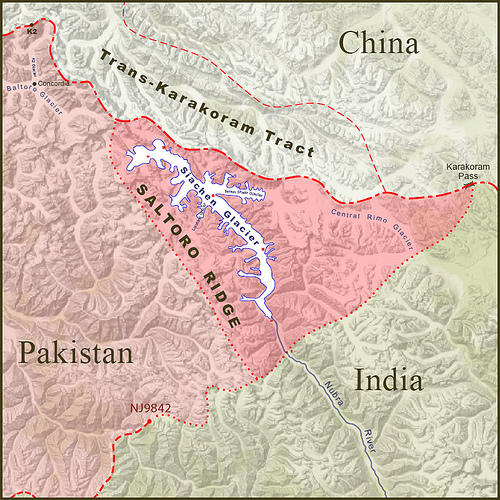
Here it is worth mentioning that this scribe has categorically been denying throughout, all claims by Indian meteorologists that Siachen and other glaciers in Jammu and Kashmir are melting due to the global warming rather than direct human activity. It has been a challenge for scientists working on climate change to understand how the adjoining Baltoro glacier on the other side of Saltoro Ridge which divides the two glaciers, does not seem to be experiencing the same effect.

The causes of recent floods in Pakistan are blamed on El Niño but very less attention is being paid to the cloud burst in Siachen and Ladakh Region, which is because of an uneven development including development of airports and helipads on various locations of glaciers. The unprecedented cloud burst broke all records of rainfall of modern recorded history of meteorological data pertaining to the region. Since last couple of years it was emphasized and urged from the Indian government to save and preserve these glaciers, as these are declared climate change indicators.

Although the scientists agreed that recent territorial monsoon rainfall has been because of the confluence of the Western Monsoon system, they failed to correlate on the reasons behind this atmospheric weather divide. It has been reported in various international research institution that rainfalls caused the 2010 floods in Pakistan. The Ministry of Foreign Affairs never raised the question of melting glaciers, which ultimately appeared disastrous for Pakistan.

In 2005, a team from the University of Newcastle, UK established this after finding out from compilation of temperature data for several instrumental records. The Karakoram and Hindu Kush Mountains of the Upper Indus Basin (UIB) had been analyzed for seasonal and annual trends over the period 1961-2000 and compared with neighboring mountain regions of Pakistan and India. Strong contrasts are found between the behavior of winter and summer temperatures and between maximum and minimum temperatures but decision makers of both countries remained unmoved. This is of particular concern on part of the Ministry of Environment and Ministry of Water and Power, which never took this issue to an international level.

Pakistan Government needs to take the case to the International Court of Justice, as the issue remains to be one of the most potent cases of climate change injustice caused to a neighboring country. An international commission should be established based on neutral climate change experts to fix the responsibility and quantify the impacts. Based on the findings, Pakistan should pursue international community to pressure India for an immediate demilitarization of Siachen and declaration of all glaciers as protected areas.

These glaciers could be handed over to UNESCO or concerned parties to avoid any future calamity. Furthermore, Pakistan should claim financial losses made due to the floods.

SDPI is an independent Pakistani think-tank based in Islamabad.
---

Related Posts: Pakistan, The Largest Land of Glaciers Part 1, 2 and 3

Disclaimer: The views expressed in this article are the sole responsibility of the author and do not necessarily reflect those of the ‘Wonders of Pakistan’. The contents of this article too are the sole responsibility of the author(s). WoP will not be responsible or liable for any inaccurate or incorrect statements contained in this post.
YOUR COMMENT IS IMPORTANT
DO NOT UNDERESTIMATE THE POWER OF YOUR COMMENT
Wonders of Pakistan supports freedom of expression and this commitment extends to our readers as well. Constraints however, apply in case of a violation of WoP Comments Policy. We also moderate hate speech, libel and gratuitous insults.


Thursday, December 2, 2010

Memories of Pakistan


   A grave may seem an unlikely setting for a celebration, but every Thursday night the derelict tomb of Baba Shah Jamal in Lahore, Pakistan, attracts those seeking spiritual ecstasy through dancing, drumming and-in some cases-hashish. Shah Jamal, a 16th century Sufi saint, used drums and ecstatic dancing to spread his faith throughout Pakistan and devotees have been upholding the tradition for more than 300 years. Today, the ministry is carried on by Pappu Sain and his two students, Gonga and Mithu Sain—resident holy men at Shah Jamal's tomb, which is also a shrine.

A feel of relationship with country and its spirit


By Aakar Patel  


It is said that right up to the time of the field marshal Ayub Khan, Pakistanis could drive across the border into India, and Indian movies were shown in all the halls of Lahore and Karachi.

Sunday, October 31, 2010

INDIA AND PAKISTAN: A RECIPE FOR PEACE


Note for WoP readers: Arundhati Roy, the famed Indian writer, peace activist and Booker Prize winning author was recently voted #3 worldwide out of '30.


Arundhati Roy and India-born head of PepsiCo, Indra Nooyi have been named by Forbes among the world's 30 most inspiring women, a list that also features Mother Teresa, Oprah Winfrey and Hillary Clinton.

"Role models mean different things to different people--some of us look for guidance in business, some in our personal lives, some of us strive to make the world a better place each day, some admire trailblazers,"

Activist Roy ranks third in the list while Nooyi comes on 10. The '30 Utterly Inspiring Role Models' list has been compiled by ForbesWoman. [Continue reading]

[Right: Angelina Jolie, the winner of Academy Award, two Screen Actors Guild Awards, and three Golden Globe Awards promotes humanitarian causes, and is noted for her work with refugees as a Goodwill Ambassador for the United Nations High Commissioner for Refugees (UNHCR). She has been cited as one of the world's most attractive people, as well as the world's "most beautiful" woman, titles for which she has received substantial media attention..During recent floods in Pakistan Jolie donated almost


twice as much as president Asif Ali Zardari toward nationwide relief efforts in the affected areas].


The publication reached out to communities on Facebook and Twitter to determine the most motivating women in the world.

Media Mogul Oprah Winfrey, who was named the Most Powerful Celebrity by Forbes, leads the pack for the most inspirational role model.

"Winfrey's role model status extends beyond her professional career; her philanthropic work, including the Oprah Winfrey Leadership Academy for Girls, is just as inspiring," Forbes said.

Others named in the list include actor Angelina Jolie, former US Secretary of State Condoleezza Rice, First lady Michelle Obama and author J K Rowling.

[Left: J.K. Rowling, the adored British author of the Harry Potter series of books. Her rise to fame has a touch of magic to it, given that she composed much of her first work, Harry Potter and The Sorcerer’s Stone in poverty, often planning out her chapters in cafés near her tiny apartment in Edinburgh, where she lived with her daughter, Jessica].

On Rowling, Forbes said, "As a single mother, Rowling took writing stories about a young wizard in a coffee shop and built one of the top-earning literary franchises ever, inspiring movies that have grossed more than $5 billion, spin-off books, theme parks and more".


Also on the list is Melinda Gates, who has "inspired many by her generosity and pledged more than $650 million to public schools through The Bill and Melinda Gates Foundation.

[Melinda Gates, American philanthropist and wife of Bill Gates wants global leaders to make women’s and children’s health a top priority. While making this demand she announced that the Gates Foundation will invest $1.5 billion over the next five years to support maternal and child health, family planning, and nutrition programs in developing countries].


"Their personal histories, outlooks and missions may be different, but each role model sets an example of how to be the best women we possibly can be," the publication said.

It was perhaps these very models in the world of femina that persuaded our writer Swaraj Chauhan to suggest that women should lead the governments, particularly so in India and Pakistan so that the permanent state of hostilities generated and abetted by the men folk could turn into an era of peace by the tender slender, peace loving hands with proven sound minds of the world of femina. [Nayyar]

Monday, January 5, 2009

Pakistan, The Largest Land of Glaciers [Part 1 of 3]

Embedded in the lap of Pakistan's mighty Karakorams (here shown in dark green)  lies Siachen (the small, dark orange part). 


THE LARGEST LAND OF GLACIERS


by Nayyar Hashmey


In Pakistan, we have more glaciers than any other land outside the north and south poles. Our glacial area covers some 13,680 sq. km which represents an average of 13 per cent of mountain regions of the upper Indus Basin. Baltistan, in our north eastern corner and in the heart of Karakorams, provides the world's most magnificent mountain scenery and mountaineering possibilities. Renowned for the largest glaciers and towering peaks, it has four 8000m peaks, and many over 7000m.


The glaciers in Pakistan can rightly claim to possess the greatest mass and collection of glaciated space on the face of earth. In fact, in the lap of our Karakoram mountains alone there are glaciers whose total length would add up to about 6,160 sq. km. To put it more precisely, as high as 37 per cent of the Karakoram area is under its glaciers against Himalayas' 17 per cent and European Alps' 22 per cent. The Karakorams have one more claim to proclaim; its southern flank (east and west of the enormous Biafo glacier) has a concentration of glaciers which works out to 59 per cent of its area.


Eric Shipton, a great mountaineer who perished in Pakistan's Northern Areas, while describing the peaks and glaciers in Pakistan wrote in his account “To describe this region is to indulge in superlatives, for everywhere you look are the highest, the longest and the largest mountains, glaciers and rivers in the world”. Making some allowance for Shipton's tendency towards slight exaggeration, born out of awe and fascination, the fact remains that Pakistan boasts of the largest share of the highest number of glaciers after the poles.

This largest ice mass in the subcontinent however, continues to mar relations between India and Pakistan.
 Located in the disputed region of Kashmir its average winter snowfall is 10.5m (35 ft.) and temperatures can dip to minus 50C (minus 58F). In spite of this severe climate, the word 'Siachen' ironically means 'the place of wild roses, a reference some people attribute to the abundance of Himalayan wildflowers found in the valleys below the glacier, but specifically refers to the thorny wild plants which grow on the rocky outcrops.

Presently the glacier is also the highest battleground on earth, where India and Pakistan have fought intermittently since April 13, 1984. Pakistan maintains permanent military personnel in the region at a height of over 6,000m and so does India. The site is a prime example of mountain warfare.

The glacier's melting waters are the main source of the Nubra River, which drains into the Shyok River. The Shyok in turn joins the Indus River. The glacier's melting waters are a major source of the river Indus, a vital water source for Pakistan


The conflict in Siachen stems from the confusion in the improperly demarcated territory on the map beyond the map coordinate known as NJ9842. The 1949 Karachi Agreement and the 1972 Simla Agreement did not clearly mention who controlled the glacier, merely stating that from the NJ9842 location the boundary would proceed "thence north to the glaciers." In the 1960's and 1970's, however, the United States Defense Mapping Agency (now National Geospatial-Intelligence Agency) issued maps showing detailed position of the area and made their maps available to the public and pilots as proceeding from NJ9842 east-northeast to the Karakoram Pass at 5534m (18,136 ft.) on the China border. Other international (governmental and private cartographers and atlas producers) confirmed this position. This implied in a cartographical and categorical allocation of the entire 2700 square kilometers (1040 square miles) Siachen area to Pakistan. However, prior to 1984 neither India nor Pakistan had any permanent presence in the area presumably due to the extremely harsh conditions which prohibited any such presence.


In the 1970s and early 1980s several mountaineering expeditions applied to Pakistan to climb high peaks in the Siachen area and Pakistan granted them, which reinforces our claim on the area, as these expeditions arrived on the glacier with a permit obtained from the Govt. of Pakistan.

The glacier is well inside Pakistani territory. However, India with a design to keep an eye over Pakistan's strategic route to China (the Karakorum Highway) in 1982 sent a training expedition to Antarctica to train under "Siachen Glacier Like" conditions. Then in April 1984, it conducted its Operation Meghdoot', and invaded Pakistani territory.


Since the Glacier is not physically connected to India (there is no natural ground routes connecting India and Siachen Glacier), therefore, it used its air force to drop all of its forces at Siachen. And still to this day uses helicopters and aircrafts to transport supplies, food and soldiers. 

On this third pole on earth, Pakistani military is confronting the Indians who have a force 5 times its size. In the process India is paying a heavy price. According to a book on the War at Siachen Glacier, 50% of Indian soldiers, who make back alive, suffer from permanent mental retardation, not to mention amputations and other terrible things that Indian soldiers have to go through. 

The war has been going on for about quarter of a century. Though the price has been heavy for both sides (especially for India), Pakistan has been slowly driving the Indians out of Siachen Glacier.

---

YOUR COMMENT IS IMPORTANT
DO NOT UNDERESTIMATE THE POWER OF YOUR COMMENT
Wonders of Pakistan supports freedom of expression and this commitment extends to our readers as well. Constraints however, apply in case of a violation of WoP Comments Policy. We also moderate hate speech, libel and gratuitous insults.


Saturday, November 29, 2008

PRESIDENT'S PEACE INITIATIVE

THE INDIAN
REACTION


by Nayyar Hashmey

The recent video conference by the President was a well thought out approach—stitch in time and a piece of statesmanship. In a world marred by terrorism and a history wrapped in mistrust on both sides of the sub continent; it has been like cool breeze in a blistering desert.
While taking down this preamble, I do give in, when AAZ took oath as a civilian President, I had a good number of reservations about his having come into power, especially in view of his past record which apparently is smeared with certain scams involving our President as the key player in the wheeling dealing he reportedly had during two stints of power in the premiership of her late wife. As a matter of fact I still have a lot - yet the latest footage of his video conference shows the man does have a vision at least on country’s foreign policy.
      In the past, both counties have been in a state of perpetual aggrandizement. The havoc caused upon people and economy during successive wars was colossal, though India – to a large extent did come out of their effect on its economy, it wasn’t so with Pakistan. Interjections of military Raj, the war in Afghanistan and post 9/11 terrorism seriously hit the economy.
     There are stark differences between the two over Kashmir, on bilateral trade, on SAARC and on a south Asian approach over international issues, but that doesn’t mean they should continue fighting on these issues. A new millennium has already dawned. Lot of changes have taken place. The world has entered an era where many things, events and happenings (which in yesteryears were engulfed in thick smoke screens) have started getting transparent, because of revolution in information science and allied disciplines; last but not the least, the compulsions of economy are such that many warring nations now take a very different course to what otherwise their history would demand. Traditional foes in Europe; France and Germany who fought one war after another sometime in the Saarland, another time in Alsace and Lorraine, Italian versus Austrians, the British and the French rivalries, all have been done away with. And all this, to reap economic benefits through collaborations instead of fighting wars, because wars eat up resources, men and many a time the countries’ geographical borders too. Economy defines their road map now. Therefore, these countries are gradually turning towards a United States of Europe. A similar road map can equally benefit the south Asian nations as well. But to achieve this objective, both need to come out of their historical rigmarole, the biases, the prejudices. Once this is done, President Zardari’s initiative especially the core theme of his address (quoting her late wife Benazir Bhutto) on ‘little bit of India in every Pakistani and a little bit of Pakistan’ in every Indian should beckon the subcontinent to enter a new era of collaboration, an ambition that can guarantee this subcontinent a permanent peace and prosperity.

And now the Mumbai Bombings:

     No sooner had I finished this note than suddenly the news started flashing before me of the Mumbai Taj Hotel blasts and firing by some militants supposedly belonging to an Islamic religious outfit called Deccan Mujahideen. It’s so tragic that whenever Pakistan and India think of coming closer to each other, a hidden hand starts sabotaging the whole process.
     Whereas it’s yet to be seen who the culprits are, regrettably the Indian Govt. have started blaming Pakistan. Best would be a joint investigation by officials of Pakistan and India to find the culprits, and whoever they are, they must be brought to book because killing innocent civilians whether in Pakistan, India or anywhere else is a heinous act which no sane person even with a bit of morality would be able to condone – whatsoever reason, whosoever the perpetrator!


Want to offer Comments on this post! Click on the CommentsTab following this line.

PRESIDENT ZARDARI'S PEACE INITIATIVE


The View Point 
by Swaraj Chauhan


     President Asif Ali Zardari is Pakistan’s first head of state to promise a “no-first nuclear-strike” against India. He talked of the need for change and reconciliation in India-Pakistan relationship, and the possibility of doing away with passports for travel between two countries.
     The surprise statement came when Zardari was addressing the Hindustan Times Leadership Summit at New Delhi on Saturday via a satellite link from his official residence in Islamabad. Telecast live from India by CNN-IBN, the session was picked up simultaneously by news channels in Pakistan.
     “Zardari borrowed a quote from his late wife (Benazir Bhutto), who once said that there’s a ‘little bit of India in every Pakistani and a little bit of Pakistan’ in every Indian. He also talked about Indians’ and Pakistanis’ ’shared bloodlines’.
     ”‘I do not know whether it is the Indian or the Pakistani in me that is talking to you today,’ Zardari said, amid applause from his high-profile audience, which included diplomats, politicians and industrialists.
“The President also talked of a common South Asian economic bloc with other countries. He suggested a ‘flexible Indo-Pak visa regime’, eliminating the travel documents now required and replacing them with a smart-card enabled e-visa system.” More here…
     The deteriorating relationship with the US administration seems to be prompting Pakistani leaders to abandon the traditional 60-year-old bitter rivalry with India. India and Pakistan have a shared heritage going back to centuries. But that came to an abrupt end in 1947 with the end of the British colonial rule and a bloody partition.
     “Polls show that the U.S. already faces ‘mounting popular opposition’ in Pakistan, which has not been significantly influenced by the election of a new civilian government in February,” wrote Jim Hoagland in July 2008 under the heading “India the Key to U.S.-Pakistan Relationship” in RealClearPolitics.
“Pakistani politicians, civil servants and military men have told me in recent months that open ‘collaboration’ with the United States is so ‘dangerous’ that they cannot afford to be seen working with the U.S.
     “India’s growing economic power will leave its neighbor in the dust unless Pakistan becomes part of that prosperity. Pakistan’s future will be determined by its relations with India, not by increased U.S. aid or maintaining its support for tribal war in Afghanistan.” More here…
The New York Times has an interesting take on India-Pakistan-US tangle…Please click here.
And to get a flavour of what the blogs are writing in India and Pakistan…here are two samples.
Please click here ….. And here….


Courtesy: The Moderate Voices
Want to offer Comments on this post! Click on the CommentsTab following this line.

Thursday, November 27, 2008

CAN INDIA AND PAKISTAN LIVE IN PEACE


by Nayyar Hashmey

Hinduism in Pakistan is viewed more in a political sense than religious, an approach that has turned both Islam and Hinduism into adversaries. The politicization of two great faiths in the subcontinent is goaded in the pages of history ever since partition of India and beyond. The Afghan King Mahmud of Ghazni in Pakistan is acclaimed more as a hero than a foreign intruder. His famous saying to Hindu priests while plundering the wealth of Somnath, when the former offered him as much money and gold as he wished but to spare the idols kept in the temple. To their appeal quipped Mahmud, “Am a destroyer and not dealer of idols”. This slogan for a long time after creation of Pakistan has been a rallying cry for the Pakistanis to develop a wave of hate against Hinduism.

While delving into this particular part of history, I came to observe that Mahmud though a Muslim was not the monarch who was determined to destroy Hinduism or spread Islam, like typical imperialist he accepted retributions from conquered peoples and then went back to Ghazni in Afghanistan. The basic aim of Mahmud like any other ruler of the ilk was to retain the largest piece from the cake, the “Gold Bird” called India (here India is synonymous with the South Asian subcontinent). Had he been a Mujahid as most of our Pakistani writers portray and believe, he should have tried to convert Hindus to the fold of Islam, which he did not – not because he was a liberal Muslim but because of his desire to amass the Indian wealth and expand his empire. Like most of the rulers who invaded the subcontinent, he either accepted reparations from Hindu rulers in the subcontinent or demanded abject obedience; in other words slavish statehood for the conquered people and the lands.


Contrary to Mahmud and quite ironically the local Muslim rulers who established themselves 
in the soil of this subcontinent like certain Afghan and Mughal rulers in the later day periods, the sad fact of history is that the Hindu’s too never accepted even those local Muslim rulers as their own (vis-à-vis the Hindu rulers) a very sad fact indeed, which created a wedge between the Hindus and the Muslims as separate and distinct identities. Then there were incidents in history like Shiva ji stabbing Afzal Khan in the back while he was invited at a dinner by the Maratha leader. Incidents like these exacerbated the gulf between Muslims and Hindus still wider.

It’s in backdrop of such incidents that relations between the Hindus and Muslims always remain tense, creating a perpetual atmosphere of rivalry between the two giants of the subcontinent, rivalry which with every passing day is getting more serious, more vitriolic thus turning the subcontinent  into a flashpoint.
No wonder then that both India and Pakistan even till this day see themselves as arch enemies. After three successive wars we have come back to square one. There still are many religious extremists on both sides of the sub continental divide, who every now and then start sabre rattling, crying for a war obliviating the very fact that both are nuclear powers.

“I lived through the whole war,” Thucydides remarks in his History of the Peloponnesian war, one of the greatest woks of history ever written, “being of an age to comprehend events and giving my attention to them in order to know the exact truth about them”.

I personally find it extremely difficult and not always possible to learn the exact truth about the enmity between the two neighbours who have fought three successive wars in our recent history. The avalanche of history books do throw further light on road to the stark truth, which otherwise would not have been possible, but its very vastness can often be confusing for in all human records and testimony there are bound to be baffling contradictions.


No doubt my own prejudices, which inevitably spring from my experience and make-up, creep thorough while I write these lines.
I detest totalitarian dictatorships in principle and come to loathe the ones we have had in our country and watched their ugly assaults upon the very noble and human spirit of Pakistan. Nevertheless in this approach I have tried to be severely objective, letting the facts speak for themselves. No incidents, scenes or quotations stem from the imagination; all are based either on documents, the testimony of eye witnesses or writers’ own personal accounts and observations.

My interpretations, I have no doubt, will be disputed by many. That is inevitable, since no man’s opinions are infallible. Those that I have ventured here in order to add clarity and depth to this narrative are merely the best I could come by from the evidence and from what knowledge and experience I have had.

Pervaiz Musharraf should probably be the last of the generals–conqueror in the tradition of Ayub, Yahya, and Ziaul Haque, or for that matter the democratically elected president and prime minister of India to start a war between two giants of the subcontinent. The curtain has however rung down on that phase of the history, at least by explosion of nuclear bombs by both, and their experimentation with the long range missiles and of satellites that hit the moon.

In our new age of terrifying, lethal gadgets, which have supplanted so swiftly the old one, the first great aggressive war, if it should come, will be launched by suicidal little madmen pressing an electronic button. Such a war will not last long and none will ever follow it. There will be no conquerors and no conquests, but only the charred bones of the dead on an uninhabited subcontinent. Should this be our fate?
_______

Photo Credits: 1st on top: All Things Pakistan, 2nd on right www.indyarocks.com and 3rd at  bottom left www.gulfnews.com


YOUR COMMENT IS IMPORTANT

DO NOT UNDERESTIMATE THE POWER OF YOUR COMMENT
Wonders of Pakistan supports freedom of expression and this commitment extends to our readers as well. Constraints however, apply in case of a violation of WoP Comments Policy. We also moderate hate speech, libel and gratuitous insults.


Search

Custom Search