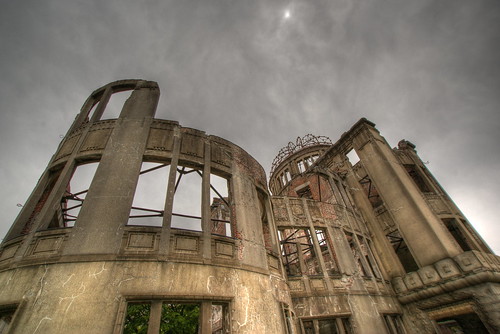
A girl prays for the atomic bomb victims in the Peace Memorial Park in Hiroshima, Japan August 5, 2007 as the city marked the 62nd anniversary of the world's first atomic bombing on August 6, 1945. Photo Reuters
INDIA AND PAKISTAN
THE NUCLEAR SHADOW
 I have taken these paragraphs mainly from a book by Dr. Ch. Jamil Anwar. The book is titled ‘Atom Bomb: The Concept and Reality’. The book intends to trace down the history of atom bomb. I wonder how Dr. Jamil has been able to describe a purely scientific matter in such an elucidating, full of interest and sensational style that even I, a student of Urdu literature was so completely absorbed in the book. I didn’t leave the book till such time that I had finished it from beginning to end.
But the particular part of the book that completely gripped me, was the one where the author describes the story of barbarism committed by the modern day hero of global war on terror, the United States of America, a hero that turns hundreds and thousands of innocent persons in the two Japanese cities into mere ash and then ‘celebrates’ this ‘men into ashes’ festivity, a festivity that makes one’s skins to crawl.
The author deserves credit for his moving style. While reading his book I felt as if I was myself a witness to this most tragic, most barbaric act in human history. His style of describing things is so absorbing that I felt I was Dr. Michihiko Hachiya myself who surprisingly came alive from the inferno called Hiroshima.
I have taken these paragraphs mainly from a book by Dr. Ch. Jamil Anwar. The book is titled ‘Atom Bomb: The Concept and Reality’. The book intends to trace down the history of atom bomb. I wonder how Dr. Jamil has been able to describe a purely scientific matter in such an elucidating, full of interest and sensational style that even I, a student of Urdu literature was so completely absorbed in the book. I didn’t leave the book till such time that I had finished it from beginning to end.
But the particular part of the book that completely gripped me, was the one where the author describes the story of barbarism committed by the modern day hero of global war on terror, the United States of America, a hero that turns hundreds and thousands of innocent persons in the two Japanese cities into mere ash and then ‘celebrates’ this ‘men into ashes’ festivity, a festivity that makes one’s skin to crawl.
The author deserves credit for his moving style.
While reading his book I felt as if I was myself a witness to this most tragic, most barbaric act in human history. His style of describing things is so absorbing that I felt I was Dr. Michihiko myself who surprisingly came alive from the inferno called Hiroshima.
What happened to Dr. Michihiko let’s listen from his own mouth:
Suddenly, a strong flash of light...
"The hour was early; the morning still, warm, and beautiful. Shimmering leaves, reflecting sunlight from a cloudless sky, made a pleasant contrast with shadows in my garden as I gazed absently through wide-flung doors opening to the south.
Clad in drawers and undershirt, I was sprawled on the living room floor exhausted because I had just spent a sleepless night on duty as an air warden in my hospital.
Suddenly, a strong flash of light startled me - and then another. So well does one recall little things that I remember vividly how a stone lantern in the garden became brilliantly lit and I debated whether this light was caused by a magnesium flare or sparks from a passing trolley.
Garden shadows disappeared. The view where a moment before had been so bright and sunny was now dark and hazy. Through swirling dust I could barely discern a wooden column that had supported one comer of my house. It was leaning crazily and the roof sagged dangerously.
Moving instinctively, I tried to escape, but rubble and fallen timbers barred the way. By picking my way cautiously I managed to reach the roka [an outside hallway] and stepped down into my garden. A profound weakness overcame me, so I stopped to regain my strength. To my surprise I discovered that I was completely naked How odd! Where were my drawers and undershirt?
What had happened?
All over the right side of my body I was cut and bleeding. A large splinter was protruding from a mangled wound in my thigh, and something warm trickled into my mouth. My cheek was torn, I discovered as I felt it gingerly, with the lower lip laid wide open. Embedded in my neck was a sizable fragment of glass which I matter-of-factly dislodged, and with the detachment of one stunned and shocked I studied it and my blood-stained hand.
Where was my wife?
Suddenly thoroughly alarmed, I began to yell for her: 'Yaeko-san! Yaeko-san! Where are you?' Blood began to spurt. Had my carotid artery been cut? Would I bleed to death? Frightened and irrational, I called out again 'It's a five-hundred-ton bomb! Yaeko-san, where are you? A five- hundred-ton bomb has fallen!'
Yaeko-san, pale and frightened, her clothes torn and blood stained, emerged from the ruins of our house holding her elbow. Seeing her, I was reassured. My own panic assuaged, I tried to reassure her.
'We'll be all right,' I exclaimed. 'Only let's get out of here as fast as we can.'
She nodded, and I motioned for her to follow me."
It was all a nightmare...
Dr. Hachiya and his wife make there way to the street. As the homes around them collapse, they realize they must move on, and begin their journey to the hospital a few hundred yards away.
"We started out, but after twenty or thirty steps I had to stop. My breath became short, my heart pounded, and my legs gave way under me. An overpowering thirst seized me and I begged Yaeko-san to find me some water. But there was no water to be found. After a little my strength somewhat returned and we were able to go on.
I was still naked, and although I did not feel the least bit of shame, I was disturbed to realize that modesty had deserted me. On rounding a corner we came upon a soldier standing idly in the street. He had a towel draped across his shoulder, and I asked if he would give it to me to cover my nakedness. The soldier surrendered the towel quite willingly but said not a word. A little later I lost the towel, and Yaeko-san took off her apron and tied it around my loins.
Our progress towards the hospital was interminably slow, until finally, my legs, stiff from drying blood, refused to carry me farther. The strength, even the will, to go on deserted me, so I told my wife, who was almost as badly hurt as I, to go on alone. This she objected to, but there was no choice. She had to go ahead and try to find someone to come back for me.
Yaeko-san looked into my face for a moment, and then, without saying a word, turned away and began running towards the hospital. Once, she looked back and waved and in a moment she was swallowed up in the gloom. It was quite dark now, and with my wife gone, a feeling of dreadful loneliness overcame me.
I must have gone out of my head lying there in the road because the next thing I recall was discovering that the clot on my thigh had been dislodged and blood was again spurting from the wound.
I pressed my hand to the bleeding area and after a while the bleeding stopped and I felt better
Could I go on?
_____
Contd..
YOUR COMMENT IS
IMPORTANT
DO NOT UNDERESTIMATE THE
POWER OF YOUR COMMENT
Wonders of
Pakistan supports freedom of expression
and this commitment extends to our readers as well. Constraints however, apply
in case of a violation of WoP Comments
Policy. We also moderate hate