Showing posts with label Religion. Show all posts

Wednesday, July 11, 2012

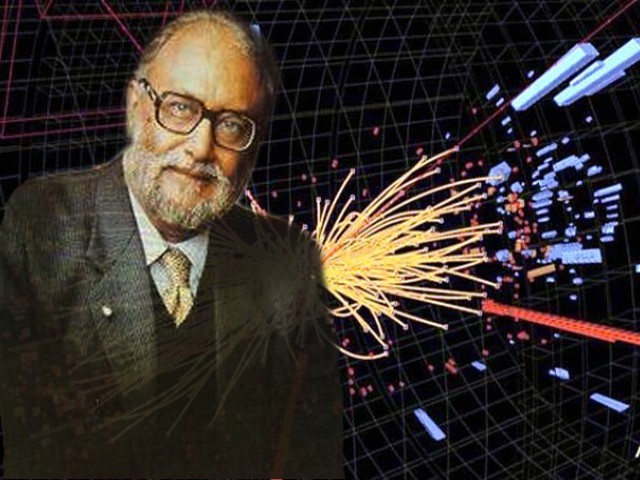
Dr Abdus Salam: Pride Pakistan does not deserve


Why take pride in his achievements now when he is gone? What suddenly makes him eligible to be a pride for Pakistan? Graphic: Sunara Nizami


REJECTING COUNTRY'S
MOST ILLUSTRIOUS SON


by Anam Khalid Alvi


Professor John Womersley, Chief Executive of the Science and technology Facilities Council, told reporters at a briefing in London that they have discovered a particle consistent with the Higgs boson
I’m sure that strikes a nerve with many knowing Pakistani’s. The Higgs’ boson, in Pakistan, is synonymous for Dr Abdus Salam; a scientist who was at the fore of this frontier of discovery in the 1970s. But rather than appreciation for his magnificent achievement, he was shunned and sidelined.
Why?
Dr Abdus Salam, Pakistan’s first and only theoretical physicist and Nobel Laureate, was also an Ahmadi.

Tuesday, July 10, 2012

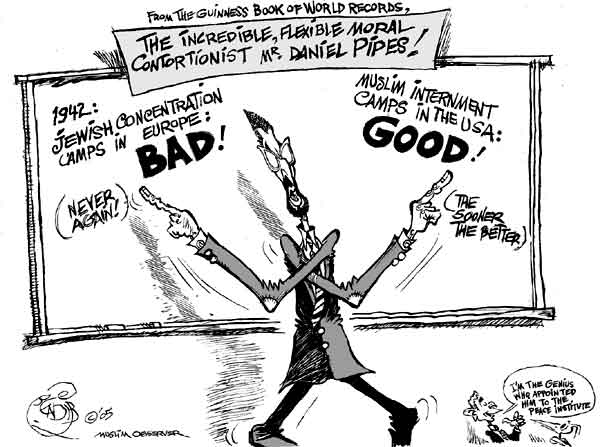
Islamophobia: A Bipartisan Project [2 of 2]


LIBERAL ISLAMOPHOBES
THE "WHITE MAN'S BURDEN" IN SHEEP'S CLOTHING
.
by Deepa Kumar

.
The events of 9/11 brought this legal apparatus in line with the foreign policy establishment. Barely had the ashes settled from the Twin Towers when loud proclamations that “Islamic terrorists” represented existential threats to the United States began to echo in the public sphere. From then on, US policy was geared towards “keeping Americans safe” from Muslim “evildoers.” The “clash of civilizations” rhetoric became the ideological basis for the wars in Afghanistan and Iraq as well as domestic attacks on Muslims and Arabs.

Thursday, July 5, 2012

O-Kay-ing Islamophobia! [1 of 2]

.


by Sheharyar Shaikh

.
.
On Saturday, June 16th, 2012, I met National Post columnist, Jonathan Kay at the "Message of Peace: Countering Islamophobia" conference hosted by University of Toronto’s Muslim Students Association and ICNA Canada. Jonathan Kay and I, along with guest speakers from the US, shared a stage panel that responded to various questions posed by the moderator and the audience on the topic of Islamophobia.


O-Kay-ing Islamophobia! [2 of 2


________________________________________________________

This image via: http://www.bobtuskin.com/2011/09/01/us-empire-foments-islamophobia/
_________________________________________________________


.
O-KAYING
ISLAMOPHOBIA IN THE WEST
.
.

by Sheharyar Shaikh
.


Contrasting Anti-Semitism and Islamophobia
.

Even though Kay considers Canada as the least likely place for Islamophobia and anti-Semitism in the western world, he discredits a real comparison between the two. In a nutshell he links anti-Semitism as arising from the idea of "flawed genetics" of the Jews, whereas he ties Islamophobia to the globally expansionist ideology of Islam. So in his view, while the Jews become innocent victims of an illogical hate, Muslims are (to be justifiably) hated for holding a "hegemonistic" ideology threatening the world.

Friday, January 21, 2011

Flagging Confidence: Waving The Tricolour In Kashmir


 Azadi
It's the only thing the Kashmiri wants. Denial is delusion

by Faisal Khan


A passenger, who had fought hard to secure a seat in an overly packed bus, temporarily left his seat to buy a cup of tea. Apprehending that his leaving the seat would result in loss of the privilege, he spread a handkerchief on the seat- - an indication that the owner of the hankie would return shortly to the seat.

Thursday, December 2, 2010

Towards Understanding Islam in the Postcolonial World Order 5/5


MOVING TOWARD


A DARK CUL-DE-SAC?


by Taj Hashmi


Calling all ethno-national freedom fighters “terrorists” does not resolve any issue but takes us all to a dark cul-de-sac. This is reminiscent of how European colonial rulers used to portray armed freedom fighters as “robbers” and “outlaws” and their armed resistance as “disturbances” or “problems of law and order”. Similarly, since the heydays of the Cold War we find Western policymakers, media and intellectuals denigrating all rebels and freedom fighters fighting Western interests as “terrorists” or “communists”.
Western ambivalence towards religion-based polities is noteworthy. While it despises the Islamic regime in Iran; the West is prepared to go to any extent to defend the Zionist state of Israel. An understanding of violent Islamist extremism hinges on the understanding of what the postcolonial Third World in general and the Muslim World in particular think of Western hegemony and arrogance. Evelin Lindner has beautifully explained it through her personal field work experience in Rwanda and Somalia in 1998. She conveys the perceptions of the downtrodden Rwandans and Somalis about the West in the following manner:
You from the West, you come here to get a kick out of our problems. You pretend to help or do science, but you just want to have some fun….You pay lip service to human rights and empowerment! You are a hypocrite! We feel deeply humiliated by your arrogant and self-congratulatory help! First you colonize us. Then you leave us with a so-called democratic state that is alien to us. After that you watch us getting dictatorial leaders. Then you give them weapons to kill half of us. Finally you come along to “measure our suffering.[25]


The writer [Taj Hashmi] is Professor of Security Studies at the College of Security Studies, APCSS, Honolulu, Hawaii. He is a Fellow of the Royal Asiatic Society of Great Britain and an editorial board member of the journal, Contemporary South Asia since 1996. Currently he’s working on a book titled Islam in Postcolonial Global Setting: Beyond the Muslim Heartland.
Email: taj_hashmi@hotmail.com
-------
Concluded.  Previous 1, 2 3, 4
Source:  Wichaar
Disclaimer: The views expressed in this article are the sole responsibility of the author and do not necessarily reflect those of the ‘Wonders of Pakistan’. The contents of this article too are the sole responsibility of the author(s). WoP will not be responsible or liable for any inaccurate or incorrect statements contained in this post.

YOUR COMMENT IS IMPORTANT
DO NOT UNDERESTIMATE THE POWER OF YOUR COMMENT
Wonders of Pakistan supports freedom of expression and this commitment extends to our readers as well. Constraints however, apply in case of a violation of WoP Comments Policy. We also moderate hate speech, libel and gratuitous insults.

[1] Frantz Fanon, The Wretched of the Earth, Grover Press, New York 2005, Ch V, pp.181-234  
[2] Oliver Roy, The Failure of Political Islam, I.B. Tauris, London 1994, pp. 75-88  
[3] Carnegie Endowment for International Peace, “The April 6 Youth Movement”, September 22, 2010http://egyptelections.carngieendowment.org/2010/09/22/the-april-6-youth-movement  (accessed November 22, 2010)
[4] Fawaz A. Gerges, Journey of the Jihadist: Inside Muslim Militancy, Harcourt, Inc. New York 2006, p.37  
 [5] Ibid, pp. 129-30  
 [6] Ioan Lewis and Anita Adam, Understanding Somalia and Somaliland: Culture, History and Society, C Hurst & Co, London 2008, p.5  
  [7] Oliver Roy, The Failure of Political Islam, I.B. Tauris, London 1994, pp.120-21  
 [8] Ibid, pp.172-3  
 [9] M. Reza Ghods, Iran in the Twentieth Century: A political History, Lynne Rienner Publishers, Boulder 1989, pp.192-230  
 [10] CNN, Fareed Zakariya GPS, June 27, 2010  
[11] Arundhati Roy, “Kashmir’s Fruits of Discord”, NYT, November 8, 2010
[12] Government of India, Ministry of Minority Affairs, Sachar Committee Report, New Delhi 2006  
[13] Harbans Mukhia, “Indian Muslims: One of a Kind”, Times of India, 20 December 2008
[14] See Greg Barton, Indonesia's Struggle: Jemaah Islamiyah And the Soul of Islam, University of New South Wales Press, Sydney 2005  
 [15] Oliver Roy, Globalized Islam: The Search for a New Ummah, Columbia University Press, New York 2004, pp.67-9  
 [16] Fouad Ajami, “The Clash”, New York Times Sunday Book Review, January 6, 2008;  
 [17] Kenan Malik, “multiculturalism has fanned the flames of Islamic extremism”, The Times, July 16, 2005
[18] Dan Ephron and Mark Hosenball, “Recruited for Jihad?”Newsweek, February 2, 2009
 [19] Rami Khouri, “Terrorists AreAlso Spawned by Humiliation”, NYT, June 29, 2010
[20] Evelin  Gerda Lindner, “Humiliation as the Source of Terrorism: A New Paradigm”,Peace Studies, 33(2), 2001, p.59
[21] Karen Armstrong, The Battle for God, Ballantine Books, New York 2001, “Introduction”
 [22] Edward Said, Orientalism, Vintage Books, New York 1979, passim
 [23] Akbar S. Ahmad, Discovering Islam: Making Sense of Muslim History and Society, Vistaar Publications, New Delhi 1990, pp. 117-40
 [24] Hafeez Malik, Moslem Nationalism in India and Pakistan, Public Affairs Press, Washington, DC 1963, pp.123-98
[25] Evelin Gerda Lindner, op cit, pp.62-3http://wondersofpakistan.blogspot.com/2010/12/towards-understanding-islam-in_4556.htmlhttp://wondersofpakistan.blogspot.com/2010/12/towards-understanding-islam-in.html

Towards Understanding Islam in the Postcolonial World Order 4/5


ISLAM AND THE WEST


by Taj Hashmi


Throughout history, most of the time, Muslims primarily fought among themselves; more Muslims than non-Muslims fell victim of Muslim wrath everywhere. The situation has remained the same; especially in the wake of the US- led invasions of Iraq and Afghanistan. They have wide-ranging problems of poverty, backwardness, bad governance, and above all, the crises of identity and integration into the modern world. Again, Muslims are not the only people reviving their faith during the last fifty-odd years; Christians, Jews, Buddhists and Hindus have been on the same path to rebel against “secularist hegemony and started to wrest religion out of its marginal position and back to center stage”. We may agree with Karen Armstrong that no religion has so far been able to withstand changes over the last four hundred years in science and technology, philosophy and ideas, and socio-political and economic systems and structures.

 Religious revival is not just retrogressive but an attempt to cope with these changes and challenges of rationalism against myths and superstitions.[21] Again, the lines between “ethnic” and “religious” are too blurred to locate the real factors behind many conflicts.
The Muslim World and the West have been at loggerheads for centuries. During the 8th and 17th centuries, Muslim caliphates and empires had been the most formidable superpowers from the Indian Ocean to the Mediterranean World. Europeans in general either remained subserviently awe stricken by their Muslim hegemons or hell-bent to turn the table to their own advantage. One gets the reflection of this love-hate relationship in the corpus of European and Turco-Arabic literature, travel accounts and history. As Dante’s The Divine Comedy (written between 1308 and1321) is an epitome of hatred for Islam and its Prophet, so is Voltaire’s play, Fanaticism or Mahomet the Prophet (written in 1736). Hegel, Francis Bacon, Marx or Max Weber, among other Western scholars, had hardly any kind word for Islam either. Hegel and Marx through their discourse of “Oriental Despotism” portrayed the Orient, including the Muslim World, as inferior to the glamorous and enlightened West. The “Orientalists” only noticed despotism, splendour, cruelty and sensuality in the Muslim World to legitimize Western colonial hegemony in the orient.[22] British colonial rulers used expressions like “mad mullah” and “the noble savage” to undermine Muslim rebels and their followers in the Middle East and South Asia.[23]
Some Muslim leaders throughout history had been extremely prejudicial and discriminatory to their non-Muslim subjects and adopted oppressive policies against Jews, Christians and Hindus. The extermination of around a million Armenians by Turks in 1915-17 may be mentioned in this regard. Not only Muslim clerics and laymen but also sections of the intelligentsia and politicians glorify early and late medieval “Islamic Empires”. One just cannot ignore Europeans’ collective memories of subjugation of their ancestors under Muslim rule as an important factor to the growth of Islamophobia in the West. Similarly, one cannot deny the history of Western colonial rule of almost the entire Muslim World; and even worse, the postcolonial Western treatment of the Muslims in general and Arabs in particular as important factors in the promotion of Westophobia among Muslims. Only Turkey may be singled out as a Muslim-majority country, which ran a parallel and rival colonial empire in Eastern Europe, North Africa and Middle East for centuries. However, the loss of Turkey’s last vestiges of its empire soon after World War I sent two ominous signals to Muslims, especially in the Subcontinent: a) that while the Muslim World was under European (Christian) domination, Muslim supremacy and conquests of non-Muslim territories (often glorified by Muslim scholars and laymen) had become history; and b) that with the demise of the Ottoman caliphate, Indian Muslims had no one else to “help them out of British paramountcy”.
 We must not lose sight of the extra-territoriality of transnational “jihads”. Al Qaeda, Taliban and their likes not only fight for the “liberation” of Arabia, Afghanistan, Palestine, Iraq and Kashmir, but they also champion the cause of establishing an alternative Global Islamic Order. Islamists always claim to be the peace-loving champions of justice against injustice and freedom against (Western) hegemony. Very similar to Communism, Islam and Islamism promote transnational camaraderie and fraternity among their adherents. Carter’s National Security Adviser Zbigniew Brzezinski’s “formal declaration of jihad” against Soviet Union from Pakistan, and the decade-long US sponsorship of the Mujahideen refurbished their image as the greatest “freedom fighters” of all times. Lessons learnt in Afghanistan and Pakistan since the 1980s should never be forgotten. Exploiting ethno-national and class conflicts, Islamist extremists have turned yester-years’ “freedom fighters” into transnational insurgents and terrorists today.
Islamism is a political ideology to regulate Muslims’ private and public affairs in accordance with Islamists’ version of the faith. Again, it is not all about violence and terrorism; there are Islamists who believe in peaceful and democratic means of establishing their version of the utopian “Islamic State”. Both terrorist and peace-loving Muslims converge on one point that it is Muslims who have been at the receiving end of Western prejudice and exploitation since the beginning of Western colonialism. Consequently it is essential that we know and empathize with the Muslim discourse of “What went wrong with the Muslim World?”, or in other words, “Is the West and its allies hell-bent on destroying Islam and Muslims?” This is not a new discourse; Muslim scholars, saints, poets and politicians have been posing these soul-searching questions for the last 200-odd years, from Egypt to Arabia and Afghanistan to India and Indonesia.[24]
 Islamism got a new lease of life in 1979. Two events that shook the world took place in that year: the Islamic Revolution of Iran and Soviet invasion of Afghanistan. Never before in history, leaders, scholars and analysts in the world took so much interest in Islam and Muslims as have they been taking since 1979. Since then, more Muslims than non-Muslims have fallen victim to Western and Islamist wrath and attacks. However, despite their differences and history of bloody conflicts between Shiite and Sunni Muslims, they often close ranks against the West. While the First Gulf War of 1991 agitated Muslims against West; US-led invasions of Afghanistan and Iraq after Nine-Eleven have simply antagonized most Muslims towards the West.
Interestingly, the overwhelming majority of Muslims who are critical of the invasions have never been sympathetic to the Taliban or Saddam Hussein. Islamist ideologues, who espouse the cause of “global jihad” against their Muslim and non-Muslim enemies, have benefitted most by exploiting the average Muslims’ hatred for postcolonial Western duplicities and hegemonic designs in the Muslim World. They love to hate anything Western, including pro-Western governments, leaders and culture. Paradoxically, some West-bashing Muslims also aspire for “Western-Style” democracy, justice and peace in the Muslim World. Since Nine-Eleven both the West and the Ummah in general are confused; and afraid of each other. By demonizing the “others”, Western and Muslim leaders, scholars and laymen justify the “inevitability” of the “Clash of Civilizations”. Muslim bewilderment and fear of Western retaliation against them led to the proliferation of denials and conspiracy theories after Nine-Eleven, which portray Jews and American government as the masterminds behind the attacks.
Source:  Wichaar
Disclaimer: The views expressed in this article are the sole responsibility of the author and do not necessarily reflect those of the ‘Wonders of Pakistan’. The contents of this article too are the sole responsibility of the author(s). WoP will not be responsible or liable for any inaccurate or incorrect statements contained in this post.
 YOUR COMMENT IS IMPORTANT
DO NOT UNDERESTIMATE THE POWER OF YOUR COMMENT
Wonders of Pakistan supports freedom of expression and this commitment extends to our readers as well. Constraints however, apply in case of a violation of WoP Comments Policy. We also moderate hate speech, libel and gratuitous insults.


Towards Understanding Islam in the Postcolonial World Order 3/5


ISLAM IN POST COLONIAL INDIA


by Taj Hashmi


Although India is not a Muslim-Majority country, it has the second or third largest concentration of Muslims after Indonesia and Pakistan; some 150 million or more.

Although perennial communal conflicts between more advanced Hindu majority and less advanced Muslim minority eventually led to the communal partition in 1947; and occasional rioting and even mass killing of Muslims in postcolonial India has been quite common, yet Indian Muslims in general do not believe in carving out another “Muslim Homeland” out of India. However, the situation in Indian-occupied Kashmir since 1947 is anything but normal. Denying the Kashmiris’ right of self-determination by violating  UN resolutions since 1948, India has kept more than one-third of its regular army and thousands of paramilitary troops in this Muslim-majority state where violations of human rights has been endemic since long. Since long leading human rights activists, including Arundhati Roy, have been publicly asking India to stop what they call the genocide of Kashmiri Muslims and to concede to the majority Kashmiris’ demand for independence.[11] 

The marginalization of Muslims in India and the frequent incidents of large-scale attacks on them by Hindu mobs – mainly instigated by proto-fascist Hindu extremist groups such as the Shiv Sena and RSS in collusion with communal Hindu law-enforcers – have been breeding Islamist militancy in northern and western India. The Muslim pogroms in the wake of the demolition of the Babri Mosque in 1992 and the Gujarat killings of 2002 may be mentioned in this regard. One finds vivid accounts of discriminations and marginalization of Indian Muslims in the (Justice Rajinder) Sachar Committee Report, appointed by the Government of India. [12] 

Despite their “second class treatment” and discriminations by the Indian government, Muslim masses in general and clerics in particular have been opposed to terrorism in the name of Islam. In 2008, 6,000 Muslim clerics from around the country gathered in Hyderabad to register their disapproval for terrorism in the name of Islam.[13] In a personal correspondence with the author, Professor Harbans Mukhia wrote (February 28, 2009): “I think in the Indian milieu of being surrounded by a vast majority of Hindus, who have no notion of the ultimate truth, the Day of Judgment and therefore no notion of proselytisation, the Indian Muslims have been far less prone to fundamentalist manifestations than others, especially as among the Arabs.”  

THE S. E. ASIAN PICTURE
 Islamism in Southeast Asia has differences and similarities with the syndrome elsewhere in the world, having its unique intra- and inter-state variations. However, prior to the recent Islamist terrorist attacks in Bali, southern Philippines and southern Thailand, scholars, political leaders and security practitioners had been complacent about any impending threat of Islamism in the entire region. They considered Indonesian and Malay Muslims’ syncretism as the main antidote to religious extremism, which is often a by-product of puritanism. Sukarno, so far the most charismatic leader of Indonesia, also played an important role in retaining its syncretistic heritage and keeping the largest Muslim-majority country relatively secular. However, Suharto’s ascendancy changed things almost overnight. He used Islamist fanatics in the mass killing of actual or so-called communists to strengthen his position; and thus legitimized Islamism and promoted political Islam for the sake of legitimacy, taking full advantage of Western “soft corner” for Islam during the prime of the Cold War. Later the emboldened and crest-fallen Islamists turned into his adversaries, turning the Jemaah Islamiyah into the most powerful Islamist organization in Southeast Asia. An al-Qaeda affiliate, JI believes in global jihad and wants to establish an Islamist state in the region, encompassing Indonesia, Malaysia, Singapore, Brunei southern Philippines and southern Thailand. [14] Ethno-nationalist separatist movements of Malay Muslims in Southern Philippines and Thailand during the last two decades have metamorphosed into Islamist movements, thanks to the growing resurgence of Global Islam.  

 ISLAM AND THE MUSLIM DIASPORA

The so-called Globalized Islam possibly exists among the Muslim Diaspora, refugees and marginalized people having no stable identity or sense of belonging to a nation or community besides the elusive transnational Ummah[15] These “nowhere men” do not represent any civilization to fight for it; they are just angry people who have fled the “burning grounds of Islam”, carrying the fire with them and angry at the world around them.[16] There are, however, conflicting views as to why Islamists among the Diaspora resort to terrorism and even suicide attacks. As one analyst explains the British suicide attacks in July 2005:  

For an earlier generation of Muslims their religion was not so strong that it prevented them from identifying with Britain. Today many young British Muslims identify more with Islam than Britain primarily because there no longer seems much that is compelling about being British. Of course, there is little to romanticise about in old-style Britishness with its often racist vision of belonging.[17]  

If we accept the above as the right explanation of terrorism by members of the Muslim Diaspora, one wonders as to how about twenty Somali-American young men from Minnesota “vanished” in 2008; went to Somalia to fight for al-Qaeda and one of them, Shirwa Ahmed, last October blew himself up killing dozens of Somali opponents of their “jihad”. These young Somali-Americans came to the US in their early childhood.[18] And the US does not promote multiculturalism. It is difficult to explain the “home-grown” Islamist terrorism; Major Nidal Hasan’s killing thirteen fellow American soldiers for example, in terms of some cultural or economic explanations. American and its allies support for Israel in general; and their invasions of Iraq and Afghanistan in particular have been the last straws.

Muslims resort to terrorism not necessarily due to religious factors. As Rami Khouri has explained the Pakistani American Feisal Shehzad’s justifications for the attempted bombing of Times Square in New York, Muslims’ sense of collective humiliation at local, national or global level by their rulers or foreign occupation forces may turn them into terrorists.[19] One cannot agree more with Evelin Lindner, renowned psychologist and founder of the Center for Human Dignity and Humiliation Studies, that:

Basically all human beings yearn for recognition and respect; their denial or withdrawal is experienced as humiliation. Humiliation is the strongest force that creates rifts and breaks down relationship among people….Men such as Osama bin Laden would never have followers if there were no victims of humiliation in many parts of the world….The rich and powerful West has long been blind to the fact that its superiority may have humiliating effects on those who are less privileged.[20] 

Next: Page 4 Islam and the west
______________________________________________________
Source:  Wichaar
Disclaimer: The views expressed in this article are the sole responsibility of the author and do not necessarily reflect those of the ‘Wonders of Pakistan’. The contents of this article too are the sole responsibility of the author(s). WoP will not be responsible or liable for any inaccurate or incorrect statements contained in this post.

YOUR COMMENT IS IMPORTANT
DO NOT UNDERESTIMATE THE POWER OF YOUR COMMENT
Wonders of Pakistan supports freedom of expression and this commitment extends to our readers as well. Constraints however, apply in case of a violation of WoP Comments Policy. We also moderate hate speech, libel and gratuitous insults.


Search

Custom Search