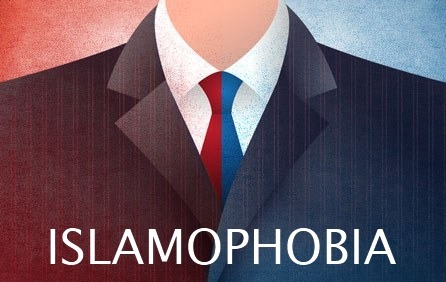
Showing posts with label Islamophobia. Show all posts

Tuesday, July 10, 2012

Islamophobia: A Bipartisan Project [2 of 2]


LIBERAL ISLAMOPHOBES
THE "WHITE MAN'S BURDEN" IN SHEEP'S CLOTHING
.
by Deepa Kumar

.
The events of 9/11 brought this legal apparatus in line with the foreign policy establishment. Barely had the ashes settled from the Twin Towers when loud proclamations that “Islamic terrorists” represented existential threats to the United States began to echo in the public sphere. From then on, US policy was geared towards “keeping Americans safe” from Muslim “evildoers.” The “clash of civilizations” rhetoric became the ideological basis for the wars in Afghanistan and Iraq as well as domestic attacks on Muslims and Arabs.

Islamophobia: A Bipartisan Project [1 of 2]


THE ROOTS OF ISLAMOPHOBIA EXPANDED MUCH BEFORE 9/11

by Deepa Kumar

Deep in the Times article, another shocking revelation that hasn’t received as much attention as the “kill list” is the Obama administration’s effort to erase the deaths of some innocent victims by categorizing “all military-age males in a strike zone as combatants.” This excludes them from the civilian casualties count, allowing the administration to claim that civilian casualties have been minimal. All Muslim men in “combat zones” in Afghanistan, Pakistan, Somalia and Yemen have been presumed to be terrorists, and therefore worthy of death, simply for being of “military age.”

Thursday, July 5, 2012

O-Kay-ing Islamophobia! [1 of 2]

.


by Sheharyar Shaikh

.
.
On Saturday, June 16th, 2012, I met National Post columnist, Jonathan Kay at the "Message of Peace: Countering Islamophobia" conference hosted by University of Toronto’s Muslim Students Association and ICNA Canada. Jonathan Kay and I, along with guest speakers from the US, shared a stage panel that responded to various questions posed by the moderator and the audience on the topic of Islamophobia.


O-Kay-ing Islamophobia! [2 of 2


________________________________________________________

This image via: http://www.bobtuskin.com/2011/09/01/us-empire-foments-islamophobia/
_________________________________________________________


.
O-KAYING
ISLAMOPHOBIA IN THE WEST
.
.

by Sheharyar Shaikh
.


Contrasting Anti-Semitism and Islamophobia
.

Even though Kay considers Canada as the least likely place for Islamophobia and anti-Semitism in the western world, he discredits a real comparison between the two. In a nutshell he links anti-Semitism as arising from the idea of "flawed genetics" of the Jews, whereas he ties Islamophobia to the globally expansionist ideology of Islam. So in his view, while the Jews become innocent victims of an illogical hate, Muslims are (to be justifiably) hated for holding a "hegemonistic" ideology threatening the world.

Friday, December 3, 2010

The Prevailing Western View On Pakistan Part 2 of 2


by Michael Hughes


The argument for Balkanizing Pakistan or, more specifically, fragmenting the Islamic Republic so it’s easier to police and economically develop, has been on the table since Pakistan’s birth in 1947 when the country was split out of a British laboratory. And lately, the concept is looking more appealing by the day, because as a result of flawed boundaries combined with the nexus between military rule and Islamic extremism, Pakistan now finds itself on a rapid descent toward certain collapse and the country’s leaders stubbornly refuse to do the things required to change course. But before allowing Pakistan to commit state suicide, self-disintegrate and further destabilize the region, the international community can beat them to the punch and deconstruct the country less violently.....
                               A f t e r
And lately, the concept is looking more appealing by the day, because as a result of flawed boundaries combined with the nexus between military rule and Islamic extremism, Pakistan now finds itself on a rapid descent toward certain collapse and the country's leaders stubbornly refuse to do the things required to change course. But before allowing Pakistan to commit state suicide, self-disintegrate and further destabilize the region, the international community can beat them to the punch and deconstruct the country less violently.

To quell any doubts about Pakistan's seemingly uncontrollable spiral into darkness, just recently, Foreign Policy Magazine ranked Pakistan as the tenth most failed state on earth and it would seem its leaders are hell bent on securing the number one slot - an honor it can add to their already dubious distinction as the world's largest incubator of jihadist extremism. Afghanistan will never see peace or prosperity with a neighbor like Pakistan and the U.S. will always be threatened by terrorist plots spawned in Pakistan's lawless regions - like the most recent Times Square bombing.

The most popular approach to fragmentation is to break off and allow Afghanistan to absorb Pakistan's North-West Frontier Province (NWFP) and the Federally Administered Tribal Areas (FATA), which would unite the Pashtun tribes. In addition, the provinces of Balochistan and Sindh would become independent sovereign states, leaving Punjab as a standalone entity.

Balkanization is based on the premise that the weak central government in Islamabad is incapable of governing Pakistan's frontiers, which have become the number one source of regional instability. The governing Punjabi elite have neglected the other three major ethnic groups - the Sindhis, Pashtuns, and Baluchis, primarily because a majority of Pakistan's budget is spent on the military rather than economic development, schooling or infrastructure. Only 2% of Pakistan's GDP, for example, is spent on education despite the fact Pakistan's literacy rate stands at 57%.

Minority groups have also been underrepresented in institutions such as Pakistan's military - which is the country's most powerful entity. Punjabis who represent 40% of the population constitute 90% of the armed forces. Pakistan's own history provides a prime case study of what happens when an ethnic group can no longer tolerate political and economic disregard. After a quarter century of strife the Bengalis rebelled, seceded and founded Bangladesh in 1971.

If the Balkanization solution is ever put in motion, accusations will surely fly that it's yet another example of U.S. imperialism and neoconservatism run amok. However, this would be a diplomatic and multilateral effort, plus, it is more about reversing the iniquities of British colonialism than it is building some new world order. 

Inherent Instability

Pakistan's problems began when the British drew its boundaries haphazardly, which was primarily a product of incompetence and haste than maniacal design. According to an article in the New York Times last year, British colonial officer, Sir Cyril Radcliffe was given six weeks to carve a Muslim-majority state from British India although he had never even been there before. Radcliffe's private secretary was quoted as saying that Sir Cyril "was a bit flummoxed by the whole thing. It was a rather impossible assignment, really. To partition that subcontinent in six weeks was absurd." It would be a comical anecdote except for the fact that hundreds of thousands of people died in the ethnic cleansing that followed as a direct result of British carelessness.

Pakistan's border with Afghanistan - the poorly-marked Durand Line - had been drawn in 1893, also by the British, but it was never meant to be a long-term legally-binding boundary. The faux demarcation split the Pashtuns in half. By reinstating the original natural boundaries, Pakistan's western provinces would be returned to Afghanistan and the Pashtun tribes would be reunited. Such a move would also remove a strategic advantage for the Afghan Taliban, who can easily blend in amongst fellow Pashtuns on the Pakistani side of the border today.

The British did not only gift Pakistan with lethal boundaries, according to renowned Pakistani journalist Ahmed Rashid, Pakistan inherited a "security state" from British rule, described by scholars as "the viceregal tradition" or "a permanent state of martial law". Intellectual Christopher Hitchens asserted Pakistan has been a fiefdom of the military for most of its short existence. As was once said of Prussia: Pakistan is not a country that has an army, but an army that has a country. Hitchens also said the country was doomed to be a dysfunctional military theocracy from day one - beginning with the very name of the country itself:

But then, there is a certain hypocrisy inscribed in the very origins and nature of "Pakistan". The name is no more than an acronym, confected in the 1930s at Cambridge University by a NW Muslim propagandist named Chaudhri Rahmat Ali. It stands for Punjab, Afghania, Kashmir, and Indus-Sind, plus the suffix "-stan," meaning "land." In the Urdu tongue, the resulting word means "Land of the Pure." The country is a cobbling together of regional, religious, and ethnic nationalisms, and its founding, in 1947, resulted in Pakistan's becoming, along with Israel, one of the two "faith-based" states to emerge from the partitionist policy of a dying British colonialism. Far from being a "Land of the Pure," Pakistan is one of the clearest demonstrations of the futility of defining a nation by religion, and one of the textbook failures of a state and a society.

Pakistan deteriorated throughout the decades because of its focus on building the military and developing Islamic extremist groups to use as weapons in their eternal obsessive struggle against India. It's true the U.S. helped Pakistan build these groups since the beginning of the Cold War, but America learned on 9/11 they had created a Frankenstein monster that now needed to be slain.

Many analysts have suggested India is less of a national security threat to Pakistan than its homegrown terrorist groups, many of which have openly declared their mission to topple the state, which would allow jihadists to secure nuclear materials. Yet, based on its strategic decision to foster extremism and its recent public support for Taliban rule in Afghanistan, it appears the biggest existential threat to Pakistan is its own political and military leaders.


The Prevailing Western View On Pakistan Part 1 of 2


by Nayyar Hashmey


In the upcoming post, Michael Hughes, a virulent Islamophobe, discusses the prospect of fragmenting Pakistan by an international force. For obvious reasons he avoids defining contours of such a force. The subject as writer himself says has been from its very outset, on the agenda of powers that helped create it.

This agenda has been very much a part of the overall schematics which a disintegrating British Empire then decided to meet her future imperialistic goals, but with a different cast.   

Before I put up this essay by Hughes, here now are some aspects of this so called balkanization, [presently being theoretised yet definitely programmed to cast the area in a new shape].

The author starts his essay with a thesis that Pakistan was created by world powers to meet their own hegemonic interests. Though partly correct, for the British did not want a huge Indian subcontinent with its vast human and natural resources, a huge land mass and geographically the most strategically placed region in Asia and thus had all the potentials to become a super power, the British had from the very beginning sensed the prospects of such a power and had endeavored as their futuristic goal, to keep the two major religious communities at daggers drawn. In this regard, the several hundred years rule of Muslim Mughal emperors was cited as the tyrannical rule of Muslims against the majority Hindus in the Indian subcontinent which was then called Hindostan.

Some time true but many times concocted excesses by Muslim rulers against their Hindu subjects were exploited to poison the minds of Hindu masses. Thus by design a big gulf was created between the two principal communities when the British preferred Hindus over Muslims in respect of employment, education and industrial development. Unfortunately the Muslim intelligentsia as well as the clergy strongly despised the western education and took it as a sin as it was from the frangi kafirs [the infidels from the west]. This created a big gap between Muslims and the Hindus resulting in Muslims’ backwardness in almost every sphere of life.

The power struggles between the Mughal rulers of Delhi versus the local Hindu Rajas both of whom fought wars to retain supremacy, further exacerbated such differences. The story of a Muslim Chieftain Afzal Khan versus Shiva Ji Rao which according to history books was stabbed by the latter when he had invited Afzal Khan to a dinner turned a story of wresting power from each other into a story of enmity between the Hindus and the Muslims.

The traditional attitude of Hindu clergy also played its own role to amplify these differences. The strong caste ridden character of Hinduism and its interpretation by Hindu priests especially against the low caste indigenous communities as well as the Muslims [whether they were converts from Hinduism or were the settled Indians who had come from neighboring countries like Turkey, Afghanistan, Iran, and central Asia] as the shoodras or the untouchables.

The Hindu clergy exercised a policy of apartheid against Muslims particularly during the post Muhghal British India thus widening the gulf between Muslims and Hindus - resulting in outbreak of communal riots in different parts of India. One of this kind took place after the publication of the book Rangeela Rasool by its Hindu publisher Raj Pal who was sentenced [on 18th Jan. 1927] to eighteen months imprisonment with a fine of Rs. 1000/- for provoking enmity between the Hindus and Muslims. The book was found to be a scurrilous satire on Prophet Muhammad (PBUH). On 6th April 1929, a Muslim youth Ilam Din stabbed Pal to death. The Lahore High Court found him guilty and sentenced him to death on 1 July, 1929. Three months later the sentence was carried out in
Mianwali jail.
.
Persistent processions and demonstrations on the one hand and assurances by notables of the Muslim community on the other that peace and order will not be disturbed if his body was returned to his family and buried in Lahore, the authorities were convinced to comply with that demand. Ilam Din received a hero’s burial and was given the honorific title of Ghazi Ilam Din Shaheed by the Muslims. During this period Hindu and Muslim relations were very hostile.

Some Anand, originally from Lahore, a journalist and author of ‘Lahore, Portrait of a Lost City’ provides some further clues. He remarks: the Hindu and Muslim communities lived like two streams, flowing side by side but never meeting at any point. To keep away from the Muslims’ “polluting touch” the Hindus had set up many barriers in their daily life. My mother for example, would never allow any Muslim to enter her kitchen. No cooked food was accepted from them. I remember how, if any of our Muslim neighbors even sent any special dish for my father, it never went beyond the dining table, a place where she did not take her own food. While eating she would never allow any of her Muslim friends or neighbors to touch her. During my childhood such inhibitions were generally not observed by male members of educated Hindu families. [Women have always been more conservative in these matters]. Some decades earlier these rules formed a strict code of conduct for all, no matter how educated or enlightened a person might be.
The Hindus had always complained of Muslim fanaticism but they never understood that the walls they raised themselves could have not resulted in any other attitude…
Some Anand continues: It took many centuries for the Hindus to realize how absurd and harmful their anti Muslim prejudices were. In this respect the first current of change was felt during the Khilafat movement in the early twenties. Though the spirit of Hindu-Muslim amity received many reverses in later years, at the social level the urban elite had changed its code of conduct for the better. This was due in part, to Western education. What this change meant was evident in my father’s attitude. When he was young, my mother used to recall, he would come back to change his clothes if a Muslim touched him while walking in the bazaar, but during my childhood in Model Town Lahore, father had several Muslim friends and he considered my mother’s inhibitions a sign of backwardness.
It was in these environments during different stages of history that the British exploited differences between British India’s two major communities.

Jaswant Singh’s Book, Jinnah, India-Partition, independence, gives further insight to Hindu-Muslim politics in pre-partition India.
The British exploited these differences to an extent that in 1940 the Muslim community felt compelled to move the 1940 Lahore resolution for an independent homeland for Muslims of British India.

The British imperialist designs and the stubbornness of All India Congress not to accommodate Muslim League in United India’s political and administrative structure did contribute to formation of Pakistan, this by no mean justifies, however, the writer’s contention that the creation of Pakistan as an independent homeland for Muslims was solely a British project. Though the British in the beginning did support the idea of a separate homeland for India’s Muslims, in fact they never wanted an independent, sovereign and powerful Pakistan. The real objective was to use Pakistan as a lever to extract concessions from All India Congress, which is why they tried their utmost to make Pakistan a weakling — to serve the imperial interests of Great Britannia. 

Dominique Lapierre and Larry Collins have in their book ‘Freedom at Midnight’ elaborated how far the British viceroy Lord Mountbatten went to woo the All India Congress and all that at the expense of Pakistan and the Muslims. Qaid-e-Azam Muhammad Ali Jinnah had always demonstrated his yearnings for a united India but the gulf that had already emerged from thousands years of living together but living in two different streams made the Muslims of India to seek some sort of identity. Now if the western writers including Hughes think that Pakistan is merely a product of religious frenzy fanned up by British to augment their own imperial interests in the post WWII scenario and now it is again in the interest of the same imperial forces to balkanize it, is entirely a wrong thesis, a thesis that might serve the interests of neo-imperialists but in no way suits the people of Pakistan.

The mess to which Pakistan has been thrown in to – by the same imperialists forces [but in collusion with the Pakistani politicians and the military playing a subservient role to the wishes of their masters in London and Washington, no doubt supports Hughes hypothesis but Hughes and those of his ilk should not forget, similar hypotheses were proferred, projected and propagated as words of eternal wisdom when the former Shah was in such a firm saddle. That Khomeini and his followers will be defeated in the same manner and style as they had been able to during Dr. Mosaddeg’s premiership proved those last words of wisdom were nothing but a figment of imagination that in a nu blew up in the air.

The Shah had to leave his imperial throne seeking asylum from one place to another. So things might appear as very bad, very sad and very depressing in Pakistan but we Pakistanis, the people of this country do see light after this night of darkness for the elites, the feudal lords and the privileged classes of Pakistan did not care for us then as they do it now BUT the people who throughout history have demonstrated a resilience to bear all bumps and jumps will definitely stand up to save their homeland. Light is bound to appear one day.
 If Hughes tries to recommend fragmentation of Pakistan through an international force, it is in fulfillment of the same old agenda which was set in 1947, i.e. fragment first India, then Pakistan and finally fragment the whole of South Asia so that it remains a tattering group of small states [and this includes Indian Union too for even in its present geography the state is too big to be acceptable to the Am-Brits’ ultimate imperial interests.


YOUR COMMENT IS IMPORTANT
DO NOT UNDERESTIMATE THE POWER OF YOUR COMMENT
Wonders of Pakistan supports freedom of expression and this commitment extends to our readers as well. Constraints however, apply in case of a violation of WoP Comments Policy. We also moderate hate speech, libel and gratuitous insults.

Thursday, December 2, 2010

Towards Understanding Islam in the Postcolonial World Order 2/5


Political Islam in the Muslim World


by Taj Hashmi


The situation in Egypt, Sudan and Somalia is not that different from Algeria; the only major difference being their different colonial experiences. Unlike Algeria, Egypt was not sharply polarized between Western and Vernacular elites, as the titular heads of state or the khedives (later glorified as kings up to 1952) ran the administration with both Western and Arabic elites. By gagging the freedom of expression, proscribing all opposition parties and even executing dissenting politicians, postcolonial rulers have left no space for constitutional politics either in Egypt. As under Nasser and Sadat, Hosni Mubarak’s government also does not allow political dissent. Since April 2008, there has been a crackdown on the anti-Mubarak “Facebook Revolution” by Ahmed Maher. This youth movement through Facebook and Twitter has been mobilizing support for boycotting sham elections under Mubarak.[3] Dissident Muslim Brotherhood and others also face persecution on a regular basis. This has paved the way for clandestine organizations, especially the Jihadists. It is noteworthy that Pan-Islamist thinker Jamal al-Din Afghani’s Egyptian “great-grand-disciple”, Hassan al-Banna was the founder of the Muslim Brotherhood; and Banna’s disciple, Sayyid Qutb directly inspired Ayman al-Zawahiri “who in 1967 established the first jihadist cell in the Arab world”. [4]


It is noteworthy that Indian (Pakistani after 1947) Islamist Maulana Maududi (1903-1979), who founded the Jamaat-i-Islami (Party of Islam) in 1941, was both influenced by the Brotherhood and his writings also influenced the latter. However, Jamaat and Brotherhood were (are) different as well; while Maududi admired fascism, Banna had admiration for socialism and wanted social justice for the poor. Interestingly, although the Egyptian Brotherhood holds a supranational ideology, the FIS in Algeria has been primarily an Algerian nationalist movement for “Islamo-nationalism”.[5]  


ISLAMISM IN AFRICA AND THE MIDDLE EAST


Islamism is not a new factor in Sudan. In 1881 Muhammad ibn Abdallah proclaimed himself the Mahdi or Messiah and declared “jihad” against Ottoman rule. The Mahdi, and after him his son Sadiq al Mahdi, ran a theocratic Mahdi State (1883-1898) in northern Sudan. The country became a military-backed theocracy during 1989 and 1999 while General Omar Bashir and the “de facto ruler”, militant cleric Hassan-el-Turabi, were in good terms. Since its relatively smooth transition to democracy after the first multi-party elections in April 2010, we may see the end of Islamist resurgence and militancy, which dogged the country for almost two decades. Sudan provides an example of how international pressure to de-Islamize the polity and the fear of total disintegration of the country worked towards democratic transition.

 Then again, we must not lose sight of the fact that Western biased media, leaders and people with extreme prejudice against everything Islamic or Muslim represent did not miss the opportunity to misrepresent the tribal civil war in Darfur as an “Arab and Islamic” onslaught on “non-Arabs” – Muslim and Christian – in southern Darfur.

Somalia is another example of colonial misgovernance and plunder. Once resourceful and fertile, Somalia went through about a century of Egyptian, Italian, British and French colonial rule. Italy and Britain controlled the country for eighty years up to 1960. While northwestern Somalia, which was under the “benign” British has a semblance of governance and law and order; the “not-so-benign” Italian controlled (1880-1960) southeastern region, under Islamist warlords and pirates is one of the least governable regions in the world posing grave threat to the security of the entire region. It seems Somalian Islamist groups, the Al-Shabab and their likes, are being inspired by the fighting traditions of Mohammed Abdullah Hassan, the “Mad Mullah” of the British colonial rulers up to World War I. [6] 

The unique Islamist regime of Saudi Arabia, which openly practices and promotes the age-old Shariah code beyond its perimeter, is a Western ally. Although scholars and leaders across the world despise the pre-modern Wahhabism, the state-ideology of the country, the oil-rich monarchy has love-hate relationship with the West. Ultra-orthodox Wahhabism emerged as an alternative to the colonial Ottoman caliphate which ran the country and the neighboring regions of Iraq-Kuwait and Greater Syria up to the end of World War I. Had there been some space for liberal nationalist movements under the autocratic Turkish caliphate, the more stringent and backward-looking Wahhabis would not have succeeded in establishing what Saudi orthodoxy represents today. The Saudi promotion of Sunni orthodoxy reflects the regime’s paranoia about pro-Iranian, anti-monarchical “Shiite heresy” and the growing Muslim Brotherhood-Iranian understanding.[7] 

ISLAMISM IN THE NON ARAB LANDS

Iran is very different from other Muslim-majority countries in many respects. Although never formally colonized by any European power, this predominantly Shiite polity remained subservient to the West until the 1979 Revolution. Iranian mullahs did not always oppose the West. The well-entrenched formally hierarchical clergy, a class of privileged landed gentry that virtually was “running a state within the state” under Muhammad Reza Shah; unlike Sunni clerics, have been well-educated in Western sciences and philosophy, including comparative religion and Marxism. [8] Had the Shah left the ayatollahs and mujtahids to themselves by not adversely affecting them by his problematic land reform program or the White Revolution, there would not have been any Islamic Revolution. [9]

In neighbouring Iraq and Afghanistan, Islamic resurgence is a by-product of what foreign invasions, ethno-national conflicts and civil wars turned them into, failing if not totally failed states. Saddam Hussein’s minority Sunni autocracy in Iraq; and more than three decade-long civil wars – fought on ethno-national / tribal and even on sectarian lines – caused and accentuated by foreign invasions and interventions in Afghanistan, led to the ongoing Islamist terrorism and ethnic cleansing in these countries. Colonial rulers’ arbitrarily drawn lines to reconstruct the political geography; and the postcolonial rulers’ denial of any space to civil societies and freedom of expression in both Iraq and Afghanistan made room for Islamism, a hotchpotch of tribal, sectarian, ethnic and other identities. Al Qaeda’s exploitative-cum-hegemonic mobilization of Sunni and Pashtun  ethno-national groups, respectively in Iraq and Afghanistan; and most importantly, American (Western) sponsorship of the “jihad” against Soviet Union in 1980 were the catalysts of Islamism in both Iraq and Afghanistan and beyond. Islamist violence in Iraq may be attributed to the Shiite assertion, Sunni retaliation and the invasion of 2003. The Afghan situation is quite complex; tribalism, ethno-nationalism, narcoterrorism and proxy wars by India, Pakistan and Iran are the main factors behind the Afghan crisis, or “quagmire” as some analysts love to use the expression with regard to Western intervention in the country. Despite the hyperboles about the “success” of the “Surge” in Iraq and Afghanistan, the fact remains that even if they emerge as stable democracies in the distant future, the Ummah is least likely to forget and forgive the US and its allies for directly or indirectly killing around a million Muslims in these countries since 1991.

Tom Friedman has aptly described the bleak, undesirable situation in Afghanistan on the CNN. To paraphrase him: “Americans’ Training Afghans to fight is like someone training Brazilians to play soccer…. Who are training the Taliban? They even don’t have maps and don’t know how to use one….America needs nation-building at home, spending another trillion dollars in Afghanistan won’t work …. American involvement in Iraq and Afghanistan may be compared with an unemployed couple’s adopting a child.”[10]  

While the situation in Pakistan to some extent is similar to that in Bangladesh vis-à-vis Islamist politics, Pakistan has probably more in common with Afghanistan and what Algeria was going through in the 1990s with regard to Islamist terrorism. It is rather too early to assume that Islamist terror in these countries is going through its passing phase. Undoubtedly al-Qaeda and the Taliban are retreating, having very little support among Pakistanis, and their support base has always been very weak and insignificant in both Pakistan and Bangladesh. Yet, both these countries are paying the price of state-sponsorship of political Islam. Again, factors responsible for the growth of proto-fascist intolerance and extremism – secular or religious – such as youth bulge, mass poverty, illiteracy, misgovernance and corruption are very much around in both Pakistan and Bangladesh. Last but not least, they are still struggling over their identities. The polities are not sure if they are primarily multi-ethnic / multi-lingual or “Islamic”.
----
Source:  Wichaar

Disclaimer: The views expressed in this article are the sole responsibility of the author and do not necessarily reflect those of the ‘Wonders of Pakistan’. The contents of this article too are the sole responsibility of the author(s). WoP will not be responsible or liable for any inaccurate or incorrect statements contained in this post.
YOUR COMMENT IS IMPORTANT
DO NOT UNDERESTIMATE THE POWER OF YOUR COMMENT
Wonders of Pakistan supports freedom of expression and this commitment extends to our readers as well. Constraints however, apply in case of a violation of WoP Comments Policy. We also moderate hate speech, libel and gratuitous insults.


Towards Understanding Islam in the Postcolonial World Order 1/5


Understanding Islam in the Postcolonial World Order


by Taj Hashmi
OVERVIEW
As the discord between modern and traditional Muslims is ideological by nature, so is the conflict between Islam and the West. And ideology is more about power, influence and identity than a mere reflection of culture and belief system. While modern Muslim elites are unwilling to concede power and privileges to the mullahs, most mullahs and their followers – mostly rural and small town lower elites with traditional Islamic or “vernacular” education – are also unwavering about not conceding any ground to non-traditional “Westernized” Muslims.

THE RISE OF POLITICAL ISLAM

The Iranian Revolution and the Taliban/al-Qaeda experiment in Afghanistan have inspired mullahs and their followers to go the Khomeini or Taliban way. Meanwhile Western duplicities and open support for Islamists during the Cold War had further emboldened Islamists within and beyond the Muslim World. State-sponsorship of Islamism by Saudi Arabia, Gulf States and Pakistan, among other states, has also been a contributing factor to the rise of political Islam. Arab autocrats promote Sunni orthodoxy to contain Shiite Iranian influence; and Pakistani rulers sometimes promote Islamists to bleed archrival India and to neutralize secular democratic opposition at home.

For distancing ourselves from any pseudo-history of Islamism, we need to understand that postcolonial Islamist re-assertion is a legacy of defeats and humiliation for the Ummah. “The death of Nasserism… in the Six-Day War of 1967”, one analyst observes, “brought Islamism as the alternative ideology in the Muslim World.”   We also need an understanding of the Muslim psyche vis-à-vis the Muslim experience in Palestine, Kashmir, Iran, Algeria, Egypt, and among other places, Iraq and Afghanistan. How the Cold War allies – Muslims and the West – turned into adversaries or competitors in an uneven “elite conflict” in the Globalized World for conflicting hegemonies and ideologies demands our attention.

We also need to discern the Cold War Islamism from the post-Cold War one. While during the Cold War, Muslims considered the West a “suspect-cum-ally”. Nevertheless, Muslims regarded the West as a friend against their common enemy, Communism. Although the end of the Cold War following the Russian withdrawal from Afghanistan had heightened Muslim optimism, they were soon crestfallen by the not-so-benign role of the West. Instead of ushering in a new dawn of hope and empowerment for Muslims, the New World Order did not bring anything new to the Muslim World. By 1991, almost all the Muslim-majority countries – barring Turkey, Pakistan, Bangladesh and Malaysia – had remain autocratic; and by 2003 three of them – Iraq, Sudan and Afghanistan – had been invaded by Western troops. In short, the cumulative unpleasant post-Cold War Muslim experience has led to the beginning of another Cold War. “Islam vs. the West” has become the new catchword. Meanwhile, pre-modern ultra-orthodox obscurantist forces had gained upper hand in many Muslim-majority countries.

Interestingly, enamoured by the concept of transnational Muslim solidarity, Muslims in postcolonial societies are grabbing the elusive Ummah as their security blanket as weak and marginalized people find security in number.

We may impute the prevalent obscurantism among sections of Muslims to their backwardness, lack of education and opportunities for various historical factors, but we cannot turn a blind eye to Western duplicities and hegemonic designs in the Muslim World. One can at best consider the Western lip-service to “democracy and freedom” in the Muslim World as condescending, insincere and deceitful; its insistence on bringing peace without justice from Algeria to Iraq and Palestine to Kashmir is simply shocking and terrifying.

ISLAMISM, A POSTCOLONIAL SYNDROME
Since most Muslim countries with a handful of exceptions were European colonies, the Muslim-West conflict is at least as old as colonialism. One may trace the roots of the conflict to early medieval era, even predating the Crusades. The inter-state conflicts between Muslim neighbours are by-products of colonialism. European colonial powers’ arbitrarily drawing lines “across the desert”, which created the states like Israel, Lebanon, Jordan, Kuwait, Pakistan, Indonesia and Malaysia and truncated entities like Syria and Iraq; have further accentuated the conflict. The postcolonial ascendancy of the Pax Americana, which coincided with the beginning of the Cold War, divided the Muslim World between pro-American and pro-Russian camps. However, the end of the Cold War signalled the beginning of another between the Muslim World and the West. In the wake of the Cold War, the overwhelming Muslim majorities globally turned anti-Western in general and anti-American in particular. They were disillusioned with the West for its continued support for Israel and regimes hostile to their interests in the Muslim World.  As substantial part of the global disempowered people, they also believe the West-sponsored Globalization process has not been beneficial to their interests at all. We must contextualize Islamic reforms, resurgence and Islamist militancy and terrorism to the dilemma of postcolonial Muslim community. They can neither forget their pre-colonial and colonial pasts, nor can they fully integrate themselves into the modern world due to various cultural and economic constraints.
The Ummah represents a racially, culturally, politically and economically diverse global Muslim community. As Muslims have economic, political and sectarian differences, they also have different ways of resolving problems, organizing dissent and protest, violently or peacefully, in the name of Islam or with secular agenda. Algerian Muslims, for example, fought a protracted bloody war of liberation against France. Algerian Muslims having the tradition of fighting a people’s war against oppressive regimes are more likely to take up arms against their enemies than Muslims in some other countries. They are not that different from Afghans. As the French colonial rulers did not allow representative self-governing institutions and relatively free press, unlike what the British experimented in its colonies; Algerians lack the tradition of organizing protests and demonstrations against their rulers in a peaceful constitutional way. The French allowed no Gandhis in their colonies either. Consequently, as Fanon has argued, the “colonized, underdeveloped man” in Algeria metamorphosed himself into a “political creature in the most global sense”. Unlike the “colonized intellectual”, the relatively free peasants posed the biggest threat to the French in Algeria. [1] The postcolonial Algerian government’s maintaining the colonial hierarchical systems, especially in the realm of education by continuing with the French and Arabic medium schools to create the employable and under-employable, French and “Vernacular” elites respectively. According to Roy, Algerian Islamist “lumpen-intellectuals”, mostly with science or engineering background, had been striving for “lumpen-Islamism”. He has demonstrated how corrupt autocracy in Algeria was responsible in culturally Islamizing the polity by toying with Islamism for the sake of legitimacy.[2]  


Source:  Wichaar
Disclaimer: The views expressed in this article are the sole responsibility of the author and do not necessarily reflect those of the ‘Wonders of Pakistan’. The contents of this article too are the sole responsibility of the author(s). WoP will not be responsible or liable for any inaccurate or incorrect statements contained in this post.

YOUR COMMENT IS IMPORTANT

DO NOT UNDERESTIMATE THE POWER OF YOUR COMMENT
Wonders of Pakistan supports freedom of expression and this commitment extends to our readers as well. Constraints however, apply in case of a violation of WoP Comments Policy. We also moderate hate speech, libel and gratuitous insults.


Search

Custom Search